Thursday, April 21, 2016

Wesołych Świąt Wielkanocnych; Joyeuses Pâques; Happy Easter

Happy Easter! I spent my Easter weekend in Kraków Poland.

I was invited to Kraków by my school mate, Ela. We met in our French language class. I have no idea why she was in my class – which was a beginning class. She is from Poland and speaks Polish, Russian and French. Me? I’m from San Diego and speak English. We sat next to each other in class and somehow developed a friendship – mainly through pidgin French (me) and hand gestures. So, she ended up inviting me to her home in Kraków.

A little history about Kraków, and places I visited (thanks to Wikipedia):

Kraków is the second largest and one of the oldest cities in Poland. Situated on the Vistula River the city dates back to the 7th century. The city has grown from a Stone Age settlement to Poland's second most important city. It began as a hamlet on Wawel Hill and was already being reported as a busy trading centre of Slavonic Europe in 965. With the establishment of new universities and cultural venues at the emergence of the Second Polish Republic in 1918 and throughout the 20th century, Kraków reaffirmed its role as a major national academic and artistic centre.

After the invasion of Poland at the start of World War II, Kraków became the capital of Germany's General Government. The Jewish population of the city was forced into a walled zone known as the Kraków Ghetto, from which they were sent to German extermination camps such as the nearby Auschwitz never to return, and the Nazi concentration camps like Płaszów.

In 1978, Karol Wojtyła, archbishop of Kraków, was elevated to the papacy as Pope John Paul II — the first Slavic pope ever, and the first non-Italian pope in 455 years.  Also that year, UNESCO approved the first ever sites for its new World Heritage List, including the entire Old Town in inscribing Cracow's Historic Centre. Cited as one of Europe's most beautiful cities, its extensive cultural heritage across the epochs of Gothic, Renaissance and Baroque architecture includes the Wawel Cathedral and the Royal Castle on the banks of the Vistula River, the St. Mary's Basilica and the largest medieval market square in Europe, the Rynek Główny. Kraków is home to Jagiellonian University (established 1364), one of the oldest universities in the world and traditionally Poland's most reputable institution of higher learning.

Wawel (pronounced as Vavel) Hill
 
Wawel Hill - Castle and Cathedral
 
The Wawel Royal Castle and the Wawel Hill constitute the most historically and culturally important site in Poland. For centuries the residence of the kings of Poland and the symbol of Polish statehood, the Castle is now one of the country’s premier art museums.

The Gothic Wawel Castle was built at the behest of Casimir III the Great, who reigned from 1333 to 1370, and consists of a number of structures situated around the central courtyard.
In the 14th century it was rebuilt by Jogaila and Jadwiga of Poland. Their reign saw the addition of the tower called the Hen's Foot (Kurza Stopka) and the Danish Tower. The Jadwiga and Jogaila Chamber, in which the sword Szczerbiec, was used in coronation ceremonies, is exhibited today and is another remnant of this period. Other structures were developed on the hill during that time as well, in order to serve as quarters for the numerous clergy, royal clerks and craftsmen. Defensive walls and towers such as Jordanka, Lubranka, Sandomierska, Tęczyńska, Szlachecka, Złodziejska and Panieńska were erected in the same period.

Rynek Główny

Main Square - Easter Market
 
Rynek Główny (Main Square) in the Old Town of Kraków is the principal urban space located at the center of the city. It dates back to the 13th century and is one of the largest medieval town squares in Europe.

The main square is a rectangular space surrounded by historic townhouses and churches. The center of the square is dominated by the Cloth Hall (Sukiennice), rebuilt in 1555 in the Renaissance style, topped by a beautiful attic or Polish parapet decorated with carved masks. On one side of the cloth hall is the Town Hall Tower (Wieża ratuszowa), on the other the 10th century Church of St. Adalbert (Kościół św. Wojciecha). Rising above the square are the Gothic towers of St. Mary's Basilica (Kościół Mariacki) built in the 14th century.

Kopalnia soli Wieliczka

Salt Mine - the walls are salt
 
The Wieliczka Salt Mine is often referred to as "the Underground Salt Cathedral of Poland." The Salt Mine is located in the town of Wieliczka in southern Poland. Opened in the 13th century, the mine produced table salt continuously until 2007, as one of the world's oldest salt mines in operation.

The mine reaches a depth of 327 metres (1,073 ft) and is over 287 kilometres (178 mi) long. The rock salt is naturally grey in various shades, resembling unpolished granite rather than the white or crystalline look that many visitors may expect.

A 3-kilometre (1.9-mile) tour with 800 steps to climb is accessed at the beginning by a wooden staircase with 378 steps that take tourists to the mine's 64-metre (210-foot) level. The mine features corridors, chapels, statues, and a lake at 135 metres (443 ft) underground. Even the crystals of the chandeliers are made from rock salt that has been dissolved and reconstituted to achieve a clear, glass-like appearance. An elevator returns visitors to the surface, which takes some 30 seconds to make the trip.

Now …. My trip …..

The trip started off on the wrong foot – well, let’s just say in the wrong week. My flight was booked for Friday the 25th of March but on Friday the 18th I received an email from Ela stating she and her family were waiting at the airport for me ….. OMG …. This language barrier was really a problem! I had written in my French notebook the date I had told her I’d come and remembered her asking me why I couldn’t come earlier and I explained to her that I had my last week of French lessons that week, ending on the 24th (she had finished the week earlier) … so I knew she, at one point, knew the date I was coming. I also remembered that I had sent her a copy of my booked plane flights (from the airlines website) so that she’d have the date/time and flight numbers ….. but here she was a week earlier, with her family in tow no less, standing at the airport wondering where I was ……. Ugh!  So I sent her an email stating that it was the next Friday I’d be arriving as well as attaching again my flight information – what else could I do, but I did feel horrible …. Her reply to me was one word – “ok”….. It’s kind of hard to read into what that one word could convey emotion-wise but unfortunately that’s pretty much how our conversations go anyways …. There is certainly no superfluous usage of words in our back and forth dialect since we don’t KNOW the words to use – our language with each other is pretty well limited to 1 to 5 words in a sentence, and there is certainly no multiple sentences used in our exchanges …. Therefore, I took her at her word and “ok” was just “okay” and I’d see her the next Friday!

My flight was at 9:30am, therefore I had to be at the airport at 7:30am ….. remember, I was on an International flight as I was flying from France to Poland …. So I had to leave my apartment at 5:30am so that I could take two metro’s to the place where a shuttle bus was leaving at 6:30am for the hour drive to the airport …. I took a low cost European airlines and it flies out of the Paris-Beauvais airport. Once at the airport I had to have my flight ticket “stamped” via a visa check …. Even though Poland is in the EU, and I live in the EU, because I am an American citizen on a US passport I had to have my passport checked and receive the “stamp” so that I could enter Poland (and had to do the same coming back to France) …. The flight was easy, a quick 2 hour hop….. and when I walked out of Customs, there was Ela waiting for me …. And my time in Kraków began …

Ela’s (her real name is Elzbieta) family consists of her, her husband Jacek (Jack) [speaks a bit of English], and two sons – Lukasz (Luka) 30 years old [speaks English perfectly], and Mariusz (Mario) 27 years old [speaks English, but I don’t think he likes to] …. They live in a 2 bedroom apartment on the third floor (no elevator) … each of the boys has their own bedroom and Jack and Ela sleep in the living room …. Luka got kicked out of his room for me to use it, so he kicked Mario out of his room and Mario stayed at his girlfriend’s place while I was there … (thus started my guilt trip) ….

The city of Kraków is absolutely beautiful, even though it was occupied by the Germans during WWII the city was not destroyed and the architecture was fabulous, and that buildings from so long ago are still standing was utterly amazing to me ….

Main Square - Town Hall Tower and the Cloth Hall
 
We went walking in the “Stare Miasto” (Old Town) two different times (they live close to the area) where I saw or visited the Rynek Główny (Main Square) which dates to 1275. We walked through the Cloth Hall, originally built in the 14th century and renovated in the 1555 after a fire, which houses many, many kiosks selling everything you can think of (certainly a tourist spot), and saw the Town Hall tower (a government building originally, with a clock high on the tower) erected in the 14th century. I saw, but did not go into the Church of St. Adalbert that was built in the 11th century. I did go into St. Mary’s Basilica, considered one of Poland’s most important Gothic architectural monuments. Since the middle ages this church has been used as a city watchtower.

Wawel Cathedral, Towers and Castle
 
We paid a visit to Wawel Hill (Castle and Cathedral) two different times …. Where we took a tour of the Castle State Rooms…. We walked to different areas of the Hill including the Dragon’s Den (I haven’t yet figured out the significance of the dragon to Poland folklore but I know it is) and on the day before Easter we went to the Cathedral to have the family Easter basket blessed by the Priest. Of course we spent time looking through the cathedral where the silver coffin of St. Stanislaus is located.  

We walked down the Kanonicza street one of the most beautiful streets in the Old Town. It was a part of the so-called Royal Tract – joining Wawel Hill and St. Florian’s Gate. The houses date back to the 1500’s. Currently the buildings house scientific and cultural institutions, including the Institute of John Paul II.  

"God the Father" stained glass (not painted) in the Franciscan Church
 
Poland is a catholic country and there are churches everywhere you look, Kraków is known as “the city of churches”. There are over 120 currently active catholic churches in the city. Other than those I’ve already mentioned, I visited the following:

·         Church of St. Peter and St. Paul – (built end of the 16th century) in front of the church as statues of the 12 apostles
·         Church of St. Andrew – (built end of the 11th century) in 1316 was given to the Poor Claire religious order (nuns) which is still active
·         The Franciscan Church – (built 1269) has a beautiful stained glass window “God the Father”
·         The Dominican Church – (built 1222) one of the largest churches in Poland
·         The Church of St. Anne – (built 1709) beautiful, ornate interior
·         Church of the Holy Virgin Mary of Lourdes – (built 1892) Ela’s home church, we went to Easter Service there

I saw the courtyard of the Collegium Maius (Greater College) which is part of the Jagiellonian University, established in 1364 by King Casimir the Great. In 1490 Nicolaus Copernicus was a student at the University. It was in this courtyard that the Germans rounded up the University professors and shipped them off to concentration or extermination camps.


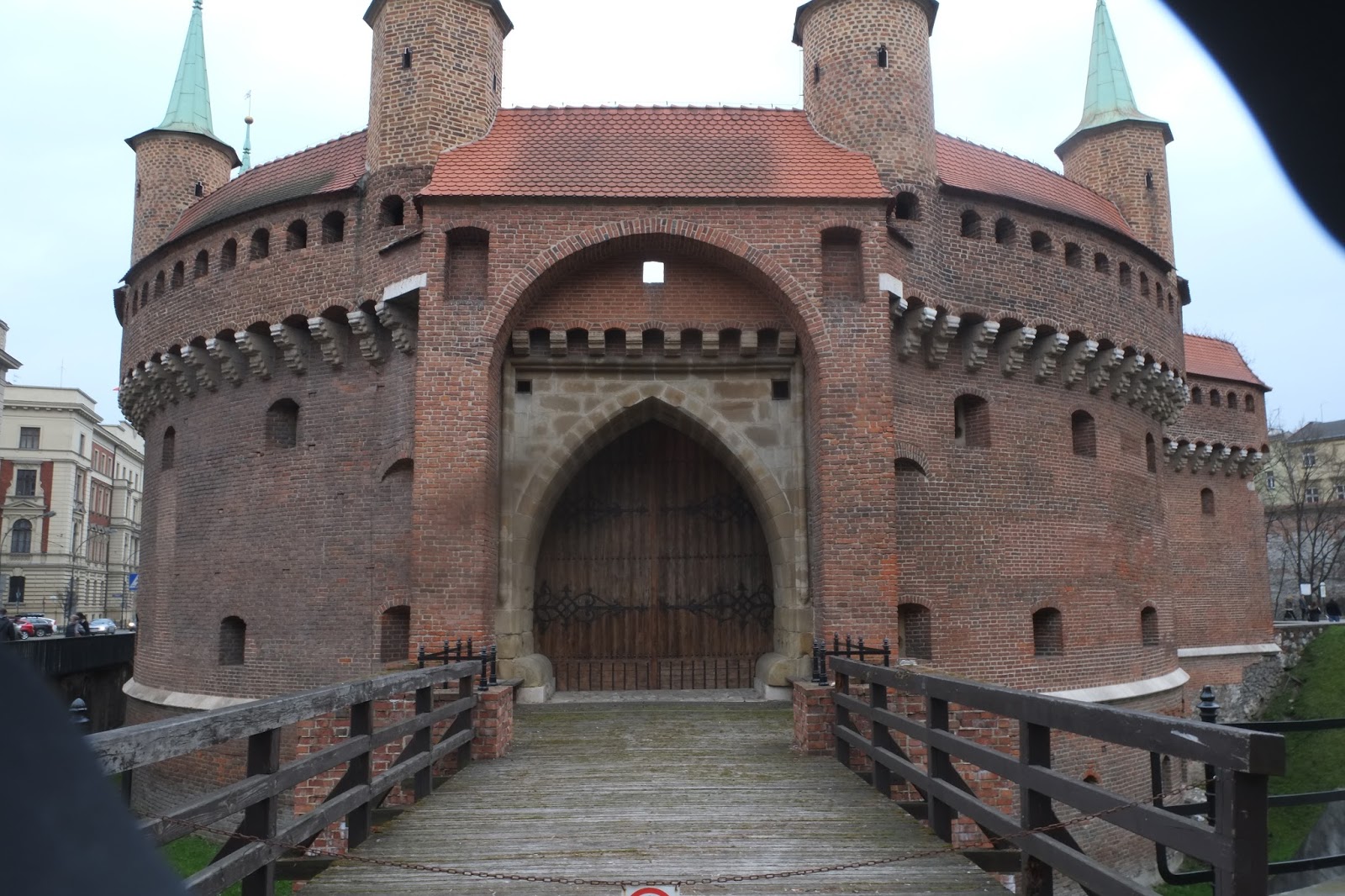
St. Florian's Gate and the Barbican
 
Originally there were 8 gates in the defense walls surrounding the medieval city. Only one still exists, St. Florian’s Gate. The city walls were constructed in the 13th and 14th century, with St. Florian’s Gate dating back to 1307. Near the gate is the Barbican, a round brick building with 3 meter thick walls and it is part of the oldest defenses of the city. It was built in the 15th century and was surround by a moat – it served as a place from where approaching enemies might be kept under fire.

The Old Synagogue
 
We visited the “Kazimierz” (Jewish quarter) one evening. There I saw the Old Synagogue. After the fire of 1557 it was reconstructed. When the Germans occupied Kraków it was greatly destroyed. The Germans used the Jewish quarter as their headquarters when they occupied Kraków. To do so, they moved all the Jews across the river (River Vistula) to the “Podgorze” (Jewish ghetto). From the ghetto the Jews were transferred either to concentration or extermination camps. It is in the ghetto where the factory is located that was the basis of the movie Schindler’s List. I didn’t have enough time to visit the ghetto nor to visit Auschwitz concentration camp (about an hour outside of Kraków). The Jewish quarter was beautiful. It just “felt” different than the other parts of Kraków I’d seen – I don’t know how to describe it. We had hot chocolate at a café, which was originally a house. To get from one room to a different part of the café you had to open up the doors to large standing cupboard and walk through the cupboard to access the other room. I don’t know if it was originally that way (the cupboard being used to hide Jews in the other part of the house) or if it is there as an example of things done to try to protect the Jews from the Germans – but it certainly is an impactful representation and reminder of the atrocities of WWII.
On Easter Sunday, after attending the church service, we went to Ela’s brother’s house in a little village, Uście Solne, about an hour drive from Kraków. There I met her brother (Jacek) [does not speak English], sister-in-law (Kasia) [does not speak English], and niece (Justyna) [speaks English perfectly].  Oh la la, was this an experience! As soon as we walked in the house everyone congregated in the kitchen which has a table that will seat 8 (good thing too, since there were 8 of us). Ela asked me if I was hungry – I kind of felt “put on the spot” so I wasn’t sure what to say, but said “sure”. So we started what ended up being hours and hours of eating ….. again, oh la la!!!!!

So …. here is how it went …..(and during all of this, there was non-stop conversations going on – everyone participated, well, except for me as it was in Polish) we started with a large bowl of Polish soup – it was a clear broth of maybe chicken flavor with pieces of green onion in it (it reminded me of a Chinese soup) but each serving also had a polish sausage in it. On the table were hard boiled eggs, cut in half, which each person put into their soup. I thought that sounded weird, but I did put half an egg in my soup and it was good – overall the soup was fabulous.  After the soup, out came the desserts. I was all for that!!!!!!! About a half an hour after the soup and dessert, Ela, her husband and her brother went to the cemetery to place flowers on the grave of her parents. She asked me if I wanted to go but I realized the others were staying at the house, so I decided I’d stay too – I thought it was just too personal of a trip and a stranger wasn’t warranted going too.

During the time they were gone, the rest of us hung around the table and at that point Kasia (the sister-in-law) asked me if she could ask me questions. I of course said she could – ask away, anything you want (I know that Europeans have an insatiable curiosity about Americans) so with Luka and Justyna translating for her (and me) I became the focal point for the next hour …. Question after question – and of course the biggest thing she (as well as most Europeans) had a hard time understanding is why I would want to live in Europe when “doesn’t everybody want to live in America?” It was a great hour (I’m smiling just thinking of it as I type this) – there were times when Luka or Justyna would roll their eyes and refuse to translate the questions for me, telling me that the question was dumb….

So, Ela et. al return. As soon as they walk into the kitchen, Kasia and Ela start preparing more food for the table …. turkey and two different salads with various vegetables …. I’m thinking, wait – we just ate an hour ago, we’re going to eat again?....... and of course the answer was “yes” …. So here we eat again and once finished, out come a second set of desserts (different from the first time, after the soup) …. And you know me, can’t say no to dessert – especially if there is something chocolate (and there was) … After that round of food is finished people got up from the table and milled round the house a bit – going into different rooms for a bit or outside to smoke …. I went outside and took pictures of the house, backyard and the street (they live in a very tiny village).

About 30 minutes goes by and everyone has meandered back to the kitchen ….. and guess what …. ANOTHER round of food is dispatched to the table … this time it’s a plate of sliced ham, bread slices, cheese slices (for sandwiches)  and two bowls of cold salads (kind of like potato or macaroni salads – that consistency) …. And to my surprise, people start eating ….. I was absolutely full and I really didn’t want to refuse, but I did because there was no way I could eat anything more …. I even asked Justyna if they always ate like this (I mean, really we were on round 5 of food) … she laughed and said only on holidays or when the family gets together ….. for the third time – oh la la! You’ll never guess what happened after that …… a third round of desserts …………. I tried, honestly I tried, but I did give into the desserts ……  it was an amazing experience!!!!!!

Jacek, Kasia,Justyna, Luka, Ela, Jacek, Mario
 
What I absolutely loved about that afternoon/evening (other than all the food – which was really, really good) is the fact that because I couldn’t understand what was being said – every once in a while they’d remember I was there and translate something for me … or say something like ‘for the last 10 minutes we’ve been talking politics again’ – I was able to not be concerned about the content of the conversation or have to think about what I would add to the conversation …. I was just able to watch the interaction between everyone talking … and EVERYONE was engaged in all the conversations – I’ve never experienced anything like it …. The conversations would fly from one topic to the next (I know they went from politics to vampires – I wonder what THAT segue was) to the next to the next … non-stop … everyone had an opinion, everyone was heard …. There were disagreements but that was okay … if someone was passionate about their view their body language would show it and their voice would get a bit louder (or at least it was for Luka) but nobody tried to brow beat another into their opinion, it was okay to not agree …. And then out of nowhere, somebody would say something (I have no idea what) and everyone would start laughing ….. then after they all laughed, another discussion would start (maybe the laughter was the segue??) ….. I kept thinking of most American discussions I’ve witnessed – where if you don’t agree with somebody’s opinion then people get pissed off (think Republicans v. Democrats) … everybody thinks that their opinion is the only one that is right/true/correct – you pick the word …. I’ve witnessed this over and over – heck, just look at your Facebook feed … it’s incredible …. But in that kitchen there was none of that (and I’ll say – Europe in general, people respect you for having a different opinion) ….it was absolutely fabulous to watch – I was actually really glad that I didn’t speak Polish because if I had, I think I would have missed all of that ….

Wall salt sculpture - Jesus with cross; Joseph with Mary and Jesus on donkey
 
My last day there, the Monday after Easter, we went to the Salt Mines…. For that trip we (Ela, Jacek and me) picked up Jacek’s cousin (I never learned her name – very bad of me) and her daughter, Ewa (pronounced Eva) who speaks perfect English. The Salt Mines are in Wieliczka about a 45 minute drive from Kraków… once there we met up with a friend of Ewa, a pilot out of Saudi Arabia who lives in Kraków, Moe…. Now, he’s interesting …. He was born in Cairo, his father Egyptian and his mother Ukrainian (I think) …. I think he had a Polish grandmother …. He went to high school in Texas (so obviously he speaks English) … he’s a pilot for a Saudi Arabian airlines – he works 25 days in a row then has 25 days off …. And he lives in Kraków and speaks Polish, Arabic and English …. At the salt mines, you must go on a guided tour so because everyone there spoke Polish (except me) and only 3 of us spoke English, we took a Polish tour guide – therefore I have no idea what was said in the tour …. Sometimes Ewa or Moe would tell me something that was said, but most times Moe would say “it wasn’t interesting” …. The way the tour is lead, I got the gist of what and how the salt was mined – it was an interesting place and I was amazed at the sculptures, all made of salt ….. at the end of the tour there is a café which is the world’s deepest restaurant ….

On Tuesday, Ela and I flew back to Paris together ….. I had a wonderful time, two of the evenings we went to their neighborhood pub, Holba, where “everybody knows your name” …. The people were just incredibly nice ….. Ela and her family were wonderful hosts and treated me like a queen …. They love their city and love to show it off … I could not have asked for a better introduction to Kraków ….


Jusqu'à la prochaine fois ... a bientôt


Friday, March 11, 2016

oh la la - fruit

Fruit, fruit, fruit, fruit …. I can’t stop thinking about fruit!

This wasn’t the topic that I was going to write about for my next blog entry but today I am a very happy girl ….. after a few months of basically only finding bananas (bananes) [yuck], oranges (oranges)  [haven’t ever eaten those], and apples (pommes) [getting to like them] when I went grocery shopping today there was fruit, fruit – yummy, yummy fruit.

I imagine I went overboard but I bought:

·       Raspberries (framboises)
·       Strawberries (fraises)
·       Blueberries (myrtilles)
·       Pineapple (ananas)
·       Grapes (raisins)
·       Golden Apples (pommes d'or)

In France, it is required that all fruit and vegetables be clearly marked what country they were grown in, all of the above with the exception of the grapes (argentine) and the pineapple (équateur), were grown in France – so I know they’re fresh!

I am so excited to eat fruit! Never thought I’d be saying those words – but it’s true. Yum, yum!
 
bon appétit

Tuesday, February 2, 2016

Leçon français : les chiffres

A short (ha!) French lesson – les chiffres [numbers].

This morning I went to the boulangerie and it was the second time I’d seen that they’ve added a new cute little cookie – bite size. I decided I’d try them; there were 9 in the basket and not wanting to only buy one or take them all, I asked for five (cinq = pronounced ‘sank’ as in ‘the boat sank’) and got 15. I guess my pronunciation wasn’t spot on! Tell me, how could I screw up ‘sank’???????

Donc, let’s talk les chiffres, d’accord [okay]? Since French is a Latin based language often words are familiar to things I already know, whether from Spanish or English.

One through fifteen, sort of, is quite like Spanish (English sure looks like the odd man out here):

French
Spanish
English
French
Spanish
English
Un
Uno
One
Onze
Once
Eleven
Deux
Dos
Two
Douze
Doce
Twelve
Trois
Tres
Three
Treize
Trece
Thirteen
Quatre
Quarto
Four
Quatorze
Catorce
Fourteen
Cinq
Cinco
Five
Quinze
Quince
Fifteen
Six
Seis
Six
Seize
 
Sixteen
Sept
Siete
Seven


Huit
Ocho
Eight


Neuf
Nueve
Nine


Dix
Diez
Ten


The above gives the false sense of security that les chiffres will be a breeze … well, let me tell you NOTHING in the French language is easy.

When we get to 17, 18 and 19 we begin having to apply math to create les chiffres as you use the two numbers from 1 – 10 to create them (the addition of the two numbers is implied): dix-six (16), dix-sept (17), dix-huit (18), dix-neuf (19). Spanish too follows this same format, but they don’t have the [-] between the two numbers and instead just write it as one word with the “10” part spelled differently, ie: dieciseis (16), diecisiete (17), etc.

Donc, the numbers in the ranges of vingt (20), trente (30), quarante (40), cinquante (50) and soixante (60) all follow the normal format, such as ‘vingt-cinq’ (25) with the exception of the numbers 21, 31, 41, 51, and 61 (yes I skipped 71, 81 and 91 – you’ll see why later) are written with the word ‘and’ in them … such as vingt-et-un (21), trente-et-un (31), quarante-et-un (41), cinquante-et-un (51), soixante-et-un (61) ….

So far, so good? It kind of makes sense (other than the “et-un” part) the more you work with it ….. now comes the absolute bizarre – even the French think the numbering format for the 70’s, 80’s, and 90’s are “très bizarre”.

The rest of les chiffres up to 100 include addition or multiplication of various numbers within the number – it’s really weird!

There is no “70” … instead it is “soxiante-dix” [60+10] … then to continue through the 70’s, instead of using the prior format, you instead use the numbers 11 – 19. Donc, 71 = soxiante-onze [60+11], 72 = soxiante-douze [60+12], 73 = soxiante-treize [60+13] …. 77 = soxiante-dix-sept [60+10+7], 78 = soxiante-dix-huit [60+10+8]

In the 80’s range is when you get to multiply ... and add …. Woohoo! Donc, 80 = quatre-vingts [literally four twenties .. 4x20], 81 = quatre-vingt-un [4x20+1 … notice no “et-un”], 82 = quatre-vingt-duex, up to 89 = quatre-vingt-neuf [4x20+9]…

The 90’s are the same format as the 70’s where there is no “90” … instead it uses the base of “quatre-vingt” with the numbers from 11 – 19. Donc, 90 = quatre-vingt-dix [4x20+10], 91 = quatre-vingt-onze [4x20+11] up to 99 = quatre-vingt-dix-neuf [4x20+10+9]…

I now understand why on checks there are two lines to write out the amount of the check because can you imagine trying to squeeze $97.85 onto an American check:

 quatre-vingt-dix-sept euro quatre-vingt-cinq cintimes

Weird. Bizzare. Archaic. The number system seems utterly strange and laborious – even the French make fun of it – yet at the same time this is what makes me love the French culture … because they keep their heritage alive.

In France, there is what is known as the “Académie française” [I bet by now you’ve seen enough French to figure out what that means] that is comprised of 40 members which, once selected, are members for life. [As a side note, one of the members – the author Frédéric Vitoux – is the uncle of one of my San Diego French teachers.]  They are “the pre-eminent French council for matters pertaining to the French language” and “the body has the task of acting as an official authority on the language; it is charged with publishing an official dictionary of the language”. The first complete dictionary was published in 1694, and the latest (8th edition) in 1935.

Here is a Wikipedia web link about the “Académie française” if you wish to learn more (pretty interesting): https://en.wikipedia.org/wiki/Acad%C3%A9mie_fran%C3%A7aise

Donc, the French protect their language with a passion, hence the lesson today in les chiffres!

PS: At French class today (I’m back in school) I had to say “1987” in French and I did it (without having to look at a number cheat-sheet)!!! WooHoo!! So I’ll close with that ….

mille neuf cent quatre-vingt-sept

Sunday, January 17, 2016

la météo

D'accord [okay], let me just put this out there – I think I’ve gone ape-shit bonkers …. I believe there are bats in the belfry!!!!

Let me explain ….. mais [but] first some background ….. I was born and grew up in Southern California – specifically Palm Springs and San Diego. Because of this, according to my internal body thermostat, I have always been cold when the temperature begins to drop the slightest bit or there is a breeze … I can think of a picture of me at the beach with another person who was in his bathing suit and I was wearing pants and a sweatshirt jacket …. I used to snow ski every winter in Salt Lake City and thought it was freezing there …. So what in the heck has happened to me?

When I arrived in Paris in September the temperatures were in the mid-60’s (if I remember correctly), I’d wear a light sweater when I was out and about and sometimes that was even too much …. Most of October was the same but maybe changing sometimes to my sweatshirt jacket (yeah, I know – not very ‘Paris like’ in this haute couture capitol) … November and December were pretty much highs of mid-50’s and lows in the high to mid-40’s … I’d wear a scarf and a winter jacket – but if the sun was shining it was really hot …. I kept asking (whom you wonder? Nobody in particular – just rhetorically) “when is it going to get cold” and I kept hoping that “maybe in January it will start to get cold so I can see what it’s like to live somewhere cold” ….. (which of course makes no sense at all, since I was usually cold in San Diego!)

During my 4 ½ months here, I always have my apartment windows open – whether it’s raining or not, no matter what the temperature is … I’ve only turned on my heater (old fashion radiator) a few times – once back in the fall when I was really sick and had a fever, and a couple of times to take the chill off the air if I’ve had the windows open all day – heck, the buildings don’t even turn on the heat for the radiators until October – that’s it! … I really haven’t needed to heat my apartment.

Donc [so] now it’s January and the temperatures are definitely dropping – the highs are in the high 30’s and the lows in the low 30’s or high 20’s …. And my windows are still open!!!!!!!! As an example, today the range per AccuWeather is the high of 4 C and the low will be -3 C (that is high 38 F and low 27 F) as I write this it is 1 C (34 F, ... remember, 32 F is the freezing point) ….. And I’m perfectly comfortable …..

What the heck is wrong with me? I’d like to blame it on menopause but that boat sailed a long, long time ago …. So I’m ‘post’ on that front …… it can’t be because I’m getting older, because in my years of observation as you get older you wear more sweaters and jackets when it’s 90 degrees (F) outside …. Can’t be because I could stand to lose a few pounds – I had more to lose when I was in the States …. The only thing I can think of is what I started this blog with …. I think I’ve gone ape-shit bonkers and now have bats in the belfry!

le temps ici est délicieux, faire de la neige, faire de la neige, faire de la neige

Monday, January 4, 2016

Mon Noël et les observations du Nouvel An

Christmas:

On my prior blog posting I wrote about some of the Christmas “traditions” throughout France. At the time I posted that blog I had not yet experienced Christmas myself, so now I’m writing about my observations of Christmas and New Year’s Eve.
I imagine you noticed when reading about the French “traditions” that there were many references to Christmas Eve. I realize that a lot of people in America celebrate on Christmas Eve (kids not being able to wait to open their presents, their own family traditions or having two sets of families to celebrate with – one on Christmas Eve and the other on Christmas Day) so even having read about the French “traditions” I thought that here in France would be similar – boy was I wrong! All celebrations are on Christmas Eve in France – Christmas Day means nothing to the French people. Which I find really weird, since Christmas is about Christ’s birth and He wasn’t born on ‘Eve’ but on ‘Day’ … yes, I know – Christmas is just symbolism, but hopefully you get the gist of what I’m trying to convey here.

So, I decided to go to a Christmas Eve service. A couple of days before I had met and talked to one of my neighbors (woohoo, I met a neighbor, Natalie – she lives on the first floor (étage 1 – remember, in the US that would be the second floor) with her daughter Victoria, and she told me that the couple who had lived in my apartment before me, Mr. and Mrs. Smith (not Brad and Angelina she stressed) worked at The American Church in Paris and that the services there are in English. I decided I’d check out the ACP as it is only about a 20 – 25 minute walk from my apartment. It’s on the quai d’Orsay, about 2 or 3 blocks from la tour Eiffel in the 7ème arrondissement. They were holding three services at 1:30pm (13h30), 7:30pm (19h30), and 10:00pm (22h00) with a 30 minute prelude of classical music, including Mozart, Bach, and Vivaldi (one of my favorites) prior to each service. I went to the 22h00 service.
I left my apartment just before 21h00 (9:00pm) so that I could watch the lights flash on la tour Eiffel  as I walked across the Champs de Mars (they flash on the hour, for 5 minutes). It doesn’t matter how many times I walk by la tour Eiffel I am always awestruck when I see it. But this stroll was so very different than anything I’ve ever experienced. During the first 10 minutes or so of my walk I did not see another person or car drive by. It was absolutely eerie. Since I don’t watch these kind of movies, I can’t give you a movie name as a reference – but you know those movies that usually star actors like Will Smith or Tom Cruise where some disaster has happened on earth and the main character finds that they are the only human left alive? That is what it felt like to me. (I had actually seen more people out and about on the day after the terrorist attacks here in Paris than I saw on Christmas Eve night). For a city that has millions of people living in it – to be able to walk through the streets and parks and not see a single person or moving vehicle I felt like I was the only person alive. That was when I realized that Christmas Eve is the day of celebration for families – the live ‘tradition’ of the French people, done the same way for centuries and centuries. When I left the church service at about 23h15 (11:15pm) there were a few more people out but still not many, it seemed like they were on their way home from their earlier family gatherings.

The American Church in Paris is the first American church established outside the United States in 1814. The current building was dedicated in 1931, and it is a small church, in 15th century Gothic style. It seats only 700 people. It is an interdenominational church serving English speaking people from different countries and denominational backgrounds. The Gothic architecture is very simplistic – it is not an ornate church by any means, but has absolutely beautiful “clean lines”. It also has a large pipe organ, which was played during the service. Below is a photograph of the pipe organ.

 
On Christmas Day I left my apartment at about 07h00 (7:00am) because I was on kitty feeding duty while her parents were out of town. As I was walking on La Motte-Picquet the first thing I saw was a city worker sweeping the gutters. This worker would be responsible for emptying the city trash cans along the sidewalks. I was somewhat dumb-founded, thinking “what in the heck is he doing emptying trash cans on Christmas Day – can’t they just leave them until tomorrow?” As I continued along my way I saw another city worker, then a city truck driving around and I also saw a gardienne (think of a New York City building superintendent) mopping the entry way to her apartment building. On my walk back home at about 08h00 (8:00am) I saw a boulangerie open, Starbucks was open, the newspaper kiosk was open (no newspapers delivered to your door here – you have to go to the newspaper stand to buy it each day), and a delivery being made to the Franprix (mini-market grocery store). Seeing all of this reinforced to me that it is Christmas Eve, not Christmas Day, that is celebrated in France.
I had a great Christmas Day because I really wasn’t alone – physically yes, but I ended up video talking to 7 different sets of people via Skype, Face Time or Facebook Messenger so it didn’t seem like I was so far away from everybody. A little bit of loneliness did creep in when it came to my “Christmas Dinner” so I made up for that by eating comfort food – I had macaroni and cheese, ham, and chocolate cake with buttercream frosting for dessert … an all American meal!

New Year’s Eve:
I’m not really a ‘party person’, those days are long in the past. I cannot remember the last time I was awake for the midnight hour to celebrate the passing of one year into the next. But, here I am in a different country wanting to learn about their customs – so I decided I wanted to experience New Year’s Eve in Paris.

The first thing I learned is that traditionally a big public celebration is not custom. I had envisioned plentiful fireworks at la tour Eiffel but learned that it’s only been the last few years that Paris has had a large public celebration (last year 650,000 people attended) which takes place at the Arc de Triomphe on the Champs Élysées.  Secondly, because of the November terrorist attacks the government wasn’t sure if they were going to allow any type of public celebration and only decided a couple of weeks before that they would allow the public celebration but there would be no fireworks – they didn’t want the noise to be misconstrued as guns being fired. And thirdly, the few weeks leading up to December 31st there were plenty of newspaper articles from Intelligence Sources about ‘chatter heard’ that a DAESH attack on New Year’s Eve at ‘iconic’ locations was a possibility in a number of countries, including France. All these put a damper on my enthusiasm of experiencing New Year’s Eve in Paris.
I’ve said in blog postings before that I’m not going to allow DAESH to impact how I live my life – I will not let them win, but for some reason in this instance I did. I’m ashamed of myself and can rationalize it away saying that I made plans to spend New Year’s Eve with friends instead – but the bottom line is that with the Intelligence reports about a possible attack I just didn’t feel comfortable being in the crowd on the Champs Élysées. Part of my reasoning for not going to the public celebration was that I knew there would be no vehicle traffic as they were shutting down the Champs Élysées and what frightened me the most was the “unknown” …. With all those people walking about there could easily (or so I thought) be suicide bombers walking amongst them. I was more comfortable with the thought that the chances of being hit by gun fire from a moving vehicle was pretty low, but not comfortable at all of wondering if the person next to me, or in front of me, or behind me was wearing a suicide vest under their winter jacket. So basically, I chickened out. And I now regret it as I’ve since learned that there were 11,000 police and military personnel along the Champs Élysées that night and every bag and purse was searched, which would also include opening your jacket for a visual check, before being allowed into the area. It was reported it was a smaller crowd this year, only 600,000 people.

So, I went to my friends’ apartment to await 2016. They live about an 8 minute walk from my apartment. They provided the food and champagne and I brought the wine and dessert. I got there around 20h30 (8:30pm) and shortly thereafter we started our grazing through the night. The French serve meals in multiple courses. We had talked about just having cheese but it morphed into much more.
We started off with saucisson (think of hard salami), very thinly sliced dried beef (I can’t remember what it’s called), white onions (like used in alcohol drinks), gherkins, green olives, and cheese crackers – this was served with the white wine. Next was ½ lobster each. They ate theirs with the French version of mayonnaise (which is supposed to be really, really good – but I have a huge aversion to mayonnaise) and I had melted butter. Then the cheese course was served; we had three types that had been bought at one of the Christmas Markets and was a regional cheese (none of us can remember which region). One was a truffle cheese (OMG, it was delicious and should be at 149 Euros per kilo), a red (in color) cheese that had tomato and basil in it, a blue (in color, not the type) cheese that had spices in it that none of us could remember, and an endive salad with hard boiled eggs - served with the red wine. We finished our gastronomical feast with various types of petit four tarts that I had picked up at my local boulangerie, fresh cherries and oranges – served of course with the champagne. Below is a picture of the desserts.

 
I left to walk home after the midnight hour. I did learn that in France there are no laws for public intoxication so I didn’t have to worry if I wobbled while I walked since we did drink the two bottles of wine and the bottle of champagne. I know I sound like a lush – I promise I’m not … what is so totally weird to me is that for years before moving here I had pretty much stopped drinking any alcohol, no reason why I just didn’t want to any longer – maybe at most 2 or 3 times a year. Here, I don’t drink every day (the perception is that French people drink wine with every meal – and they DO) but when I do have wine it doesn’t feel the same, I don’t feel fuzzy. French wine is very, very, very good!!!

Extra Bonus:
I am in love. He is just an adorable boy.


I don’t even know his name. He lives at the café on the corner of my block (I always see him in the café, I don’t know if the owners live in the apartment above it or not). The café opens at 11h00 (11:00am) and if I happen to walk by between 10h00 and 10h30 (10:00am and 10:30am) I can sometimes find him outside on the sidewalk. The other day I cracked up because somebody was walking their large dog and my little love had his back arched and the hair standing straight up – I started laughing and called him over to me where I pet and pet him until he settled down. He is so friendly and recognizes me. When I see him inside the café, either before it opens or after it’s closed, I tap on the window and he comes to the window where I “pet” him through the window – like scratch his head. He moves his body against the window as if he can actually feel my fingers in his fur.
In this picture, it was taken just the other morning – early, he was sitting in the window seat and when he saw me he started standing up and stretching against the window. In the window reflection you can see me taking the picture and the bottles in the bar of the café across the street.

I am in love. He is just an adorable boy. I don’t even know his name.

Jusqu'à la prochaine fois