Tuesday, January 31, 2017

Ma première année ou plus


On September 1st I celebrated living in Paris for 1 year. My plan was to move here for two years – to travel in Europe and Eastern Europe – then decide if I wanted to live in Europe forever, and where. I picked Paris as my starting point because it is a good central hub that allows me to easily travel anywhere else in Europe and Eastern Europe. I knew my first 9 – 12 months would be spent assimilating to the European, and specifically French, culture (easily accomplished) and learning the French language (ha! Not even remotely accomplished). So, having been here a year I wanted to look back to see what my year looked like – but since I was remiss in completing my blog I’m now at 1 ½ years, so I’ll update you to the end of 2016:

Visitors: I was lucky enough throughout the year to be able to meet up with friends, old and new, from the States – Fred and Diana; Rosemary; MJ, Allen, Gail and Robert; Ilyana; David and Tessa; Arnie and Suzie; David and Beth; Jeanne and Jerry; Tony, Dominique and Andrew; Karen and Nancy; and Leonard, Terri and Art – all made Paris either a stop on their journey or the journey itself. For many of them Paris was a return visit, while for the others it was a first visit. Whether new or a return, it is always delightful to see my home town (ha! Paris is my home town – can you believe that???) through the eyes of other people.

New Friends: For me it’s not very easy to meet new people so this adventure of mine is certainly pushing my boundaries. I have been extremely fortunate to become friends with some pretty wonderful people – Jacqui, whom I met through an ExPat website, moved to Paris from the San Diego area and is married to a Frenchman. She has expertly guided me, with the patience of a saint, through the many ‘differences’ between living in the USA and in France ….. things such as introducing me to Castorama (like Home Depot) to accompanying me to my appointment at the Tax Office. A huge plus, is that I get to babysit her cat when she is out of town – woohoo (I sure do miss having a cat or two or three or four).  She has since moved back to Encinitas, which makes me very sad, but I’m hoping that she will soon return to Paris!
Bridgette, Lucien and Dominique, whom I met through friends from the States, they live just outside of Auxerre (France) which is about a 2 ½ hour train ride – it is in north-central France. I’ve been to their place a couple of times and they make jaunts to Paris frequently – usually when Dominique is on school break – to do things that the big city offers …. But they are also big rugby fans so they’ll come up for a day to watch a game too. It’s always nice to see them.
Another friend is Elisbeta who lives in a suburb of Paris but is from Poland. I met her in our language class … what is interesting there is that she speaks Polish and French, I speak English but somehow we figured out how to communicate with each other. Over the Easter week-end I went to Krakow, Poland to visit her in her hometown and meet her family. It was a lovely time.
I met one of my neighbors – Nathalie – when she happened to be walking by my apartment and saw me struggling to talk to a delivery person …. She stopped and translated for us …. She speaks perfect English and went to college in Atlanta. She and her daughter, Victoria, live on the floor above me and they both have helped me when I have “where do I …..” questions.  I’ve been invited to their apartment a number of times and I love spending time with them. Nathalie told me she doesn’t have the patience to help someone learn French, but she introduced me to two of her friends – Monique and Virginie – who both want to improve their English, so I meet up with them and we trade off – one meeting in English, the next in French (I bet you can guess whom is progressing better in the pairings …. Ha!)
I met Christopher when I was at the police department in the 5th arrondissement, touring the Police Museum. He is a civil police officer (they have two types of police officers here – civil for civil law, and criminal for criminal law) who speaks English and has a gregarious personality …. He is so informed about the history of Paris and knows all these off-the-beaten-path, really cool, places to visit. He’s also helping me (more like forcing me) with my French as he often pretends he has no idea what I’m saying if I speak or write in English – he always says “I don’t understand. In French, Nicolle” …. So the poor guy then has to try to figure out what I’m trying to convey – thank god he laughs easily, because with me trying to speak French we often are reduced to laughing fits.
And Muxu I met at a street market in a neighborhood close to me. It’s one of my favorite street markets (Avenue de Saxe) and I like to take visitors there because the vendors arrange their products so beautifully – it’s artistic. He is a vendor who sells scarves – and he has had a lot of business from me, because I just love scarves. I am addicted and it is hard for me to visit him without purchasing another scarf that I “just have to have”. He too helps me with learning French, as I also help him with English.

Travels: I moved here to travel, yet this first year – as I suspected – I did little traveling. I have gone a couple of times to a small village, Arcy-sur-Cure, which is located just outside of Auxerre – in the Bourgogne (Burgundy) region of France. My friends Bridgette and Lucien own a “Bread and Breakfast” at which I stay. Arcy-sur-Cure is a small commune in north-central France and the caves in that commune hold the second oldest cave painting known. The population is about 521.
Bridgette is a trained Chef, so I always have great food there. My first time there I was introduced to food from the Bourgogne region – the one that stands out the most is SNAILS. Oh Lordy, I really had no desire to eat any but I didn’t want to offend them (this was during my first meeting them) and their son, Dominique, was downing them like they were chocolate candy – I didn’t want a 10 year old kid showing me up so I ate one – with the entire table watching me, as well as my friend Fred videotaping the event – thank goodness he’s never been able to figure out how to download the video from his cell phone so that way I don’t feel obligated in sharing it with you ….. and I only ate the ONE … it was basically tasteless (the snail itself) – I felt like I had a small piece of rubber in my mouth that I was chewing on, all the flavors came from the garlic-butter sauce that it is in …… I could maybe come to like them if it was for the texture of the snail itself – again, like chewing rubber – and just the thought that I am eating a snail …. But I survived. I went to their place again for Thanksgiving where we had a traditional American Thanksgiving meal …. Well, with 21 people invited …. About ¾ spoke English, so I had people to talk to – the meal was excellent (of course – do Chefs ever make bad meals?) …. And it was a quite enjoyable couple of days there.
As you blog readers are already aware – I went to Krakow, Poland – I spent 4 days there, it is a beautiful city and the people were very warm and welcoming (see blog dated April 21, 2016).
In October I went to Mont Saint-Michel, about a 4 hour bus ride each way, which is an island commune in the Normandy area about a half mile off the north-west coast of France. The population is 44 people.  Since the 8th century AD it has been the home of a monastery and has always been a strategic fortification for France. What is so unique about it is that when the tide recedes you can walk to the island (daytime) and then in the evening when the tide comes back in the island is completely surrounded by water. The tides can vary greatly, at roughly 14 metres (46 ft) between high and low water marks.
I was in Malaga, Spain (Andalusia), which lies on the “Costa del Sol” of the Mediterranean, at the end of October – thanks to the Miranda clan. I was there for a week and we went all kinds of places – we actually stayed about 30 minutes outside of Malaga, in Calahonda …. Because this area is the southern coast of Spain on the Mediterranean Sea (I stuck my feet into it) the weather was warm and beautiful. Actually, the entire area reminded me of San Diego and sometimes of the drive to Yuma …. Other cities in Spain that we visited were: Marbella (posh resort), Ronda (bullfighting and arched bridges), and Granada (La Alhambra), along with some smaller towns. I am always fascinated by architecture and the Andalusia area had beautiful buildings most with the Moorish influence from the occupation centuries ago. A nice surprise for all of us was that Gibraltar (as in – the rock of) was about an hour away – so of course we went there too. It is a British overseas territory located near the southwestern tip of Europe near the Iberian Peninsula. At the top of the rock there is a nature reserve where the Barbary Macaque (rock apes) live – they look like monkeys to me!
The last place, outside of Paris, I visited was Chartres (France) in December. It is about 60 miles southwest of Paris and is known for its cathedral, the Cathédrale Notre-Dame de Chartres, which is considered one of the finest and best preserved Gothic cathedrals in France and in Europe. The stain glass windows in the cathedral are unique in that it is not known how the famous and unique blue, bleu de Chartres, of the glass was created, and it has been impossible to replicate it. It’s a small village with about 39,000 people.

Paris Sites: I’m often asked “What do you do?” ….. It’s kind of a hard question to answer, but my basic answer would be that I just live life everyday here ….. Some days I never leave my apartment – I have clean house, do laundry (including ironing the bed linens …. And, you’ll never believe this but I now iron my bath towels too ….. oh, just hit me in the head!) …. I grocery shop ….. Other days I just walk/wander around looking at things – there is so much to look at because there is nothing like Paris in the US ….. and other times I visit tourist known, and unknown, landmarks. So, to try to figure out what I’ve done this past year I’m listing the things I’ve “seen”:
The Eiffel Tower (I have to start with that one, as I’ve made more visits there than anywhere else – because it’s literally 2 blocks from my apartment and 7 minutes walking to its base ….. and I will admit, I’m still as in awe of it as the first time I saw it in 1998 …. It still takes my breath away each time I see it);
Parks: Champ de Mars; Square Saint-Lambert; Parc du Bois; Le Jardin d’Acclimatation; Jardin des Tuileries; Square René Viviani; Square du Vert-Galant; Parc Georges Brassens; Jardin Tino Rossi; Square Cambronne; Parc des Buttes-Chaumont; Jardin du Luxembourg
Suburbs of Paris: Boulogne-Billancourt; Saint Cloud; Saint-Ouen; La Défense; Sevrés; Saint-Denis; Vincennes; Bourget
Misc. Places: Seine River; Rue Crémieux; Canal Saint-Martin; Cirque Pinder; Garde Républicaine Quartier des Célestins
Parades: (may 8); Bastille Day (July 14)
Landmarks: Trocadéro; Invalides; Catacombes; Place de la Concord; Place de la République; Place de la Bastille; Notre Dame; Sainte Chapelle; Sacré-Cœur; Arc de Triomphe; Le Garnier (Opera house); Centre Georges Pompidou; Ecole Militaire; Archives Nationales; Abbey of Saint Germain des Près; Russian Ambassador House; Hôtel de Ville de Paris; Saint-Denis Gate; Saint-Martin Gate; Passage des Panoramas; National Library of France – François Mitterrand; Père-Lachaise Cemetery;  Moulin Rouge; Basilica of St. Denis; Château de Vincennes; Panthéon; Saint Etienne-du-Mort; Saint Sulpice; Saint-Eustache Parish
Districts: Montmartre; Le Marais; Montparnasse; Pigalle; Les Halles (and actually almost all districts in Paris)
Churches (attended): American Church of Paris; Calvary Chapel Paris; Hillsong
Music Scene/Sports: Le Grande Rex (to see the band my cousin is in); L’Olympia (Black Viola and 2Cellos); Euro2016 (International soccer)
Street Markets: Rue Cler; Grenelle (my neighborhood); Avenue de Saxe; Marche aux Puces
Shopping Centers: Beaugrenelle; Bizarre Hôtel de Ville; Les 4 Temps (La Défense); Galeries Lafayette; Le Bon Marche; Champs-Elysées;
Museums: Musée des Collections Historiques de la Préfecture de Police; Fondation Louis Vuitton; National Museum of Sevrés Céramiques; Musée de Picasso; Musée de l’Orangerie; Institute Pasteur; Conservatoire National des Arts & Métiers; Carnavalet Museum/Cernuschi Museum; Le Musée en Herbe; Musée Galliera de la Mode de la Ville de Paris; Musée de Chocolat; L’Aquarium de Paris; Le Bourget Musée Air et Espace; Musée Rodin; Grand Palais
Bridges: Pont Alexandre III; Pont d’Lena; Pont de Grenelle; Pont de Bir-Hakeim; Pont Neuf;(almost every bridge that crosses the Seine)
Places of the 13 November Terrorist Attacks: Le Petit Cambodge; Carillon Paris; Café Bonne Biere; Casa Nostra; Bataclan; La Belle Equipe; Le Comptoir Voltaire

Language: I went to 10 weeks of French lessons (very expensive – oh la la) and received my A1 certificate. I’m pretty proud of that, and I know I have to start somewhere, but in reality – I don’t speak French. I can read it fairly well, I can do okay writing it but the speaking part is still very painful for me and listening to it is worse – I just have a really hard time understanding the spoken word. I have a long way to go to get to the point where I can actually converse. But hey, I did, once, put three sentences together at the same time!!!!

I’m sure I’ve missed things that I’ve experienced in my first 16 months here … so that’s a picture of my life so far in Paris - I’ll close for now. My next blog will have pictures and will be about some quirky things in Paris !

Vivre la vie

Tuesday, August 9, 2016

quelques perles que je recommande ...

When you live in a City that is full of “Bling, Bling” you sometimes forget to notice the gems that can standout just as much – if you take the time to find them.

Paris is known for many “have to do’s” such as la Tour Eiffel, les Champs-Elysées, Notre-Dame de Paris, Sacré-Cœur Basilica, musée d'Orsay, Château de Versailles,  and le Louvre, and yes you must see these absolutely mind boggling sights – but, truly … once you’ve seen le Louvre you never need to go back …. The Mona Lisa (La Gioconda) painted by da Vinci (1503 – 1506) is disappointing – it is small, dark and nothing really stands out about it … yet the statue known as ‘Venus de Milo’ (real name is: Aphrodite of Milos) is breath taking, especially knowing that it was created between 130 – 100 BC.

I’m finding the gems not on the tourist “beaten path” the most enjoyable, so I thought I’d share some of them with you.
 
Le Musée de l'Orangerie
This museum isn’t an ‘unknown’ museum, but I’ve yet to have anyone say they wish to visit it – and it has become one of my favorite museums!

Housed in which was once l’orangerie in the jardin du palais des Tuileries (the ‘Tuileries Palace’ – now known as le Louvre, near Place de la Concord  where King Louis XVI and Queen Marie Antoinette were beheaded during the French Revolution, ending the rule of France by royals) is an art gallery of impressionist  and post-impressionist paintings.

It is most famous for being the permanent home for eight Water Lilies murals by Claude Monet, the museum also contains works by Paul Cézanne, Henri Matisse, Amedeo Modigliani, Pablo Picasso, Pierre-Auguste Renoir, Henri Rousseau, Alfred Sisley, Chaim Soutine, and Maurice Utrillo, among others.
 

Water Lilies - Claude Monet

 
Le Musée de la préfecture de police
This museum is located in the 5th arrondissement on the 3rd floor of the Police Department (Hôtel de police) and it is free.

The history of law enforcement (in its many forms) is found in this museum – starting in 1254 with the creation of “the night Watch and the night Watch knights” whose motto “Vigilat ut quiescant” (He’s watching so they rest) is still the current motto of the police Préfecture.
In 1667 King Louis XIV created the Lieutenancy General of Police (lieutenance générale de police) for special issues of security and public order within Paris. It was disbanded at the start of the French Revolution in 1789, and was replaced by the current Préfecture de Police created by Napoléon I on February 17, 1800.

The museum has the various uniforms from throughout the centuries, maps of Paris from the different times, many documents – including arrest warrants, a guillotine, the instruments of Alphonse Bertillion – who founded in 1883 the ‘Bertillion system’ to identify individuals (suspects) adopted throughout Europe and the United States and still used up to 1970, various crime weapons, histories of notorious French criminals, as well as the influence on the police department during the various wars including the French Revolution and the occupation by the Nazi’s.

Police Museum
 
When you visit, and enter the Police Department – on the ground floor – see if “Toff” is working the front desk. If so, identify yourself as a police officer (or retired police officer) if you are, or if not, tell him you know me. He is the nicest person I’ve met so far in France! And, as a bonus – he speaks English.
 
Le Musée national de Céramique-Sèvres
The real name of this museum is Sèvres – Cité de la céramique (Sèvres City of Ceramics) created from the merger of the Musée national de Céramique-Sèvres and the Manufacture nationale de Sèvres.
The museum, opened in 1824 was the first museum dedicated to fine ceramic arts in the world. The goal was to collect and study fine ceramics from all over the world and this is evident by the display of ceramics from every corner and time period of the world: antiquities (a piece from Cyprus: 1300 BC), Islam countries (Iran: 1311), Asian countries (China: 10th century), the Americas (Mexico: 1600’s), Renaissance (Italy: 1575) … as well as those ceramics made in France and other European countries.
On display is dinnerware used by Kings and Queens, vases, and statuary … both old and contemporary designs are on display. Below is a picture I took of a candelabra that is about 7 feet tall – the absolute beauty in the detail of the statuary was stunning to me.
 
Ceramic Candelabra - so delicate, so beautiful 
 

Le Musée des arts et métiers
The Museum of Arts and Crafts is an industrial design museum in Paris that houses the collection of the Conservatoire National des Arts et Métiers (National Conservatory of Arts and Industry), which was founded in 1794 as a repository for the preservation of scientific instruments and inventions.
Among its collection is an original version of the Foucault pendulum, the original model of the Statue of Liberty by Auguste Bartholdi, some of the first planes (Clément Ader's Avion III, Louis Blériot's Blériot XI, Blaise Pascal's Pascaline (the first mechanical calculator).The museum presents seven different collections: Scientific Instruments, Materials, Energy, Mechanics, Construction, Communication, and Transportation.
It was fascinating seeing the scientific instruments, some from before 1750 … along with the communications area where a printing press (1750) was located, to a ‘modern’ color television (one of the first) to a CRAY supercomputer to satellites sent into space.  An interesting museum.


Le Musée Carnavalet

OMG!!!! This museum is the gem of all gems to visit. It is dedicated to the history of Paris and it houses collections tracing the development of the city from prehistoric times to the present day. A huge selection of works of art, mementos and scale models on display show how the city looked in different eras.
There is a “sign gallery” showing the signs spanning from the 16th to the 20th centuries. Shopkeepers, whose customers were often illiterate, attracted the attention of customers by using picture signs. The chat noir cabaret sign hung at the foot of the Butte de Montmartre hill in 1881.

Le Chat Noir Cabaret
 
Paris in the 16th, 17th and 18th centuries have rooms recreated from former Kings – in particular King Louis XVI. There is also a cabinet of items belonging to Queen Marie Antoinette. I’m currently reading a book by Madame Campan “Memoirs of the Court of Marie Antoinette, Queen of France: Being the Historic Memoirs of Madame Campan, First Lady-in-Waiting to the Queen”, which made seeing the items related to Marie Antoinette and King Louis XVI all the more meaningful to me.
There are rooms dedicated to the French Revolution, the Second Empire and the Third Republic. Leading into the 20th century where there is a room that recreates the bedroom of Marcel Proust.
 
Queen Marie Antoinette Personal Items
 

Le Train Bleu
Le Train Bleu ("The Blue Train") is a restaurant located in the hall of the Gare de Lyon railway station in Paris, France. The restaurant has served drinks and meals to travelers and other guests since 1901 in an ornately decorated setting. Initially called "Buffet de la Gare de Lyon", it was renamed "Le Train Bleu" in 1963, after the famous train of the same name.
There are 41 paintings, each of which portrays a different scene from the beautiful sites along the old railway network or famous events of the 1900’s.
 
Le Train Bleu Restaurant - Gare de Lyon, Paris
 

rue Crémieux
In the 12th arrondissement, a beautiful pedestrian street with colorful houses (so un-Parisian). 
 
Colorful Houses - reminds me of the "Painted Ladies" in San Francisco
 
It is named after Adolphe Crémieux (1796-1880), lawyer and politician, member of the Gouvernement de la défense nationale.  He is also the author of a famous decree of 1870 which gave French nationality to Jews in Algeria.
beautifully painted tree on the front of the house
 
Not only are the houses colorful, some have additional interesting painted additions such as a blossoming tree on the front of the house, a bird in flight, and a cat leaping from a window sill towards geese on the floor below. Every time I see these houses I think of the “painted ladies” in San Francisco.

the cat jumping towards the geese
 

Two Oldest Houses
The two oldest houses in Paris are in Le Marias district, the historical heart of the capital (the 3rd arrondissement).
The oldest house in Paris is located at 51 rue de Montmorency.
The rue de Montmorency was named in 1768 after the Montmorency family, prominent residents of Le Marais during the Renaissance period. The Montmorency family is one of the oldest and most distinguished families in France, derived from the city of Montmorency, now in the Val-d'Oise département, about 9 miles (15 km) northwest of Paris. As the Montmorency was a noble family, the street lost its name at the French Revolution. Therefore, it was known between the end of the French Revolution and 1806 as the rue de la Réunion.
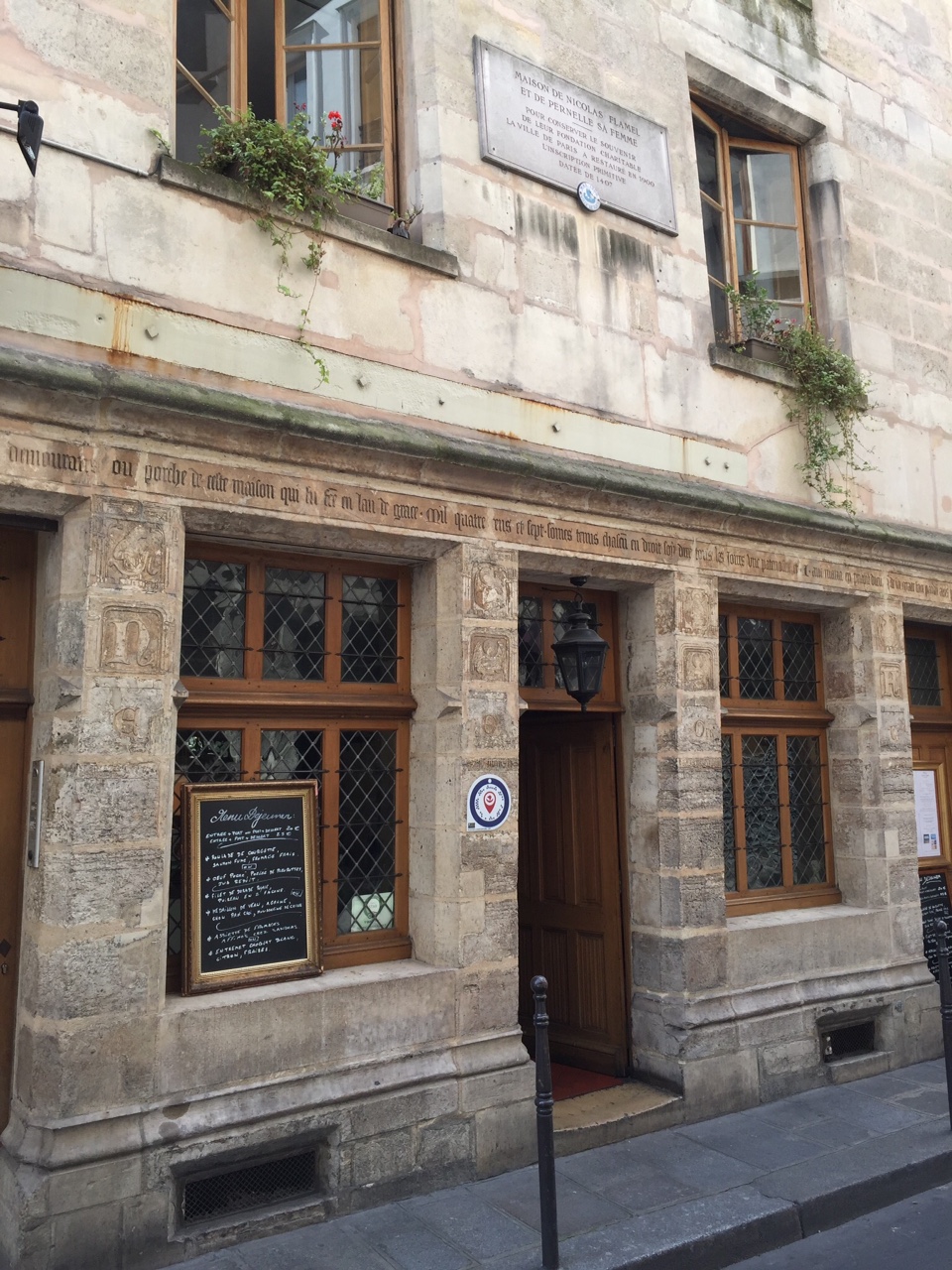
The house of Nicolas Flamel was built in 1407 by Nicolas Flamel himself and still stands, the oldest stone house in Paris, at 51 rue de Montmorency. The ground floor, always a tavern, currently houses the Auberge Nicolas Flamel (a restaurant). Nicolas Flamel, a scrivener and manuscript-seller who developed a reputation as an alchemist, claimed that he made the Philosopher's Stone which turns lead into gold, and that he and his wife Pernelle achieved immortality.
On the facade of the building you can still read this inscription: "Nous homes et femes laboureurs demourans ou porche de ceste maison qui fut faite en l'an de grâce mil quatre cens et sept somes tenus chascun en droit soy dire tous les jours une paternostre et un ave maria en priant Dieu que sa grâce face pardon aus povres pescheurs trespasses Amen" ("We, ploughmen and women living at the porch of this house, built in 1407, are requested to say every day an 'Our Father' and an 'Ave Maria' praying God that His grace forgive poor and dead sinners").
 
Oldest house in Paris - Le Marias
 
The second oldest house in Paris is located at 3 rue Volta.

While the house dates to 1644, the street was named well after that time (I don’t know the name of the street when the house was built). Currently, the ground floor is a Chinese restaurant.
Rue Volta was named after the Italian-born Count Alessandro Giuseppe Antonio Anastasio Volta (1745-1827). He was a physicist, and while professor at the University of Pavia in Italy, his experiments with gases led to his discovery of methane and that its ignition produces an electric spark. The world volt for a unit of electricity derives from his name – Volta. He also invented the battery in 1800. In 1810 Napolèon brought him to Paris and made him a count, but in 1819, at 74 years old, he returned to Italy where he would die. This Paris street was named after him in 1851.

Second oldest house in Paris - Le Marias District

Note: There are older buildings in Paris, such as Notre-Dame de Paris which was started in 1163 (there is still a wall and door from that time period), and La Sorbonne (opened in 1150, it is the second oldest University in the world) was completed in 1257.
 
Dancing on the Quai Saint-Bernard
Every evening, from June until the end of August, hundreds of dancers gather spontaneously at the Jardin Tino Rossi, on the Quai Saint-Bernard. The night I walked by I saw a number of different areas dedicated to dance, with the music genres of Swing, Samba, Tango and Celtic playing. Good thing there wasn’t any Country/Western playing – or I might have embarrassed the friend I was with and started dancing myself!
The Jardin Tino Rossi combines a promenade along the Seine and an open-air museum of late 20th century sculpture. In the 19th century, the site of the Jardin Tino-Rossi, on the quai Saint-Bernard in the 5th arrondissement, had been the place where wine barrels were unloaded from barges for sale at the nearby Halle aux vins. In 1975 it was decided to make the quai into a promenade, featuring rows of trees planted along the quai in the 19th century, and a series of small garden amphitheaters by the edge of the water. In 1980, a more ambitious element was added; an outdoor sculpture garden featuring over fifty works by late 20th-century sculptors, including Alexander Calder, Constantin Brancusi, and Jean Arp.
 
 
Dancing at the Jardin Tino Rossi


Lorsque vous visitez Paris - chercher les joyaux inconnus ....


Saturday, July 2, 2016

Fromage, fromage et plus de fromage


“A meal without cheese is like a day without sunshine” – French proverb
 
"Comment voulez-vous gouverner un pays qui a deux cent quarante-six variétés de fromage?" (How can you govern a country which has two hundred and forty-six varieties of cheese?) – French President Charles de Gaulle, 1962.


Street Market "Fromager"

France can be traced back to the Iron Age (approx. 1200 BC – 700 AD) when inhabited by the Gauls, a Celtic people. The area, now known as Metropolitan France, was annexed in 51 BC by the Roman Empire, which was held Gaul until 486 AD when the Germanic Franks conquered the region and formed the Kingdom of France. In the Late Middle Ages, after its’ victory in the Hundred Years’ War (1337 – 1453), France emerged as a major European power. During the Renaissance, French culture flourished and a global colonial empire was established, which by the 20th century would be the second largest in the world. (reference: Wikipedia)
Tradition – (noun). “ 1. the handing down of statements, beliefs, legends, customs, information, etc., from generation to generation, especially by word of mouth or by practice, 2. something that is handed down, 3. a long-established or inherited way of thinking or acting, 4. a continuing pattern of culture beliefs or practices, 5. a customary or characteristic method or manner”  (reference: Dictionary.com)

There are unwritten, unspoken rules – traditions – regarding French cheese etiquette. Le fromage – its consumption is one of the “Big 3”, along with pain (bread – think baguette) and vin (wine), cultural aspects that define ‘the French’.
According to a 2013 report by the International Dairy Federation, the French eat – per person – 25.9 kg of cheese per year (nearly half a kilogram per week), the Americans eat 15.4 kg and the British 11.6 kg.

There’s a certain etiquette (tradition) to be observed when serving and eating cheese in France (taken from an article in The Local):
1. Cheese is not an appetizer. First of all, serving cheese as an appetizer before dinner like Americans often do is unheard of in France. And you won't see it on a cocktail stick with a pickled onion and tomato. In fact serving cheese at any time of the day or night is a non non (no-no). Just stick to its’ allotted slot in a meal which is....

2. Before dessert. In the UK, finishing a meal with cheese and grapes is quite common, but in France they wouldn't finish a meal with cheese and their reasoning is sound. Just think how smelly some of their most famous fromages are. Imagine all your dinner guests continuing to debate the invasion of English into the French language with deathly Camembert breath. They'd be laid out on the floor. That is why the French always follow cheese with some kind of dessert, which could even be grapes. So don't serve them together.
3. Not a cracker in sight. The French will think you're crackers, if you serve the cheese with anything other than bread. Although it doesn't always have to be baguette. They believe that crackers take away from the taste of the cheese. So keep your selection box well-hidden for when you're on your own.

4. Save a bottle of red. It would be a major faux pas if you had gone through all your vin rouge and had no red left for the cheese course. In general red wine is served with cheese in France, though not always. What wine to pair with what cheese is a whole new subject that can be saved for another rainy day, but often pairing a wine with a cheese from the same region is one way to do it. Another is just to experiment, though the French tend to stick to what they know, which is red.
5. Like wine, cheese needs to breathe. Cheese that has been cooped up in its wrapping in the fridge is not immediately ready to be eaten. Instead, take out the cheese and prepare it on a plate at least an hour before it’s meant to be eaten. Room temperature is where those delicious aromas and flavors really thrive.

6. Odd is better than even. If you’re the one putting together the cheese plate, keep in mind that there should always be an odd number of cheeses, for aesthetic purposes. And in order to maintain balance in the universe, there should be a minimum of three varieties: a soft cheese, a hard cheese, and one blue or goat cheese.

7. Cutting the cheese. Cutting French cheese, one of the most crucial aspects of cheese behavior, is a matter of geometry and manners. There is a right way and a wrong way, and it all depends on the shape.

For round cheeses, it’s pretty straightforward: pie slices, about the thickness of a pencil. For log-shaped goat cheese, go for parallel slices. For square cheeses, triangles are the way to go. For a rectangular cheese like Comté, just cut slices parallel to the rind. Those pyramid-shaped cheeses should be cut into one slice and then halved again. For wedges of Brie, don’t cut off “the nose” — the tip of the cheese closest to the center that holds the most flavor. Instead cut along the side of the wedge so that others can have a taste of the most flavorful part. The same goes for Roquefort. If you take all the flavorsome mold in the middle, it will bring a swift end to the entente cordiale. Cut in a diagonal shape, so you get a lot of the side and just a little of the middle.

You might wonder why your host wouldn’t pre-slice the cheese to save foreign guests the headache and panic of wondering how to do it, but that would be compromising the moisture and flavor of the cheese, an obvious faux pas.

Additionally, never – never take more than 3 pieces of cheese no matter how many different types of cheese are on the serving platter.

8. Small piece of bread, small piece of cheese. Don’t go plopping a whole wedge of cheese on a hunk of bread like some kind of savage. Think small piece of bread, small piece of cheese. Just gently place the morsel of cheese on the bite-sized morsel of baguette. And resist the urge to spread the cheese — it’s not Nutella.

9. Mildest to strongest. When eating your cheese, start with a milder one and work your way up to the smelliest of the bunch. For example: start with Brie, move on to the goat cheese, then the blue, then the Camembert. That way your taste buds will still be able to appreciate the mild Brie as well as the stinky Camembert.
10. Don’t mix the cheeses. For the love of all things cheesy, if there’s no designated knife for each fromage, wipe the knife off on a piece of bread when you’re moving from cheese to cheese. Nobody likes cheese cross-contamination.

11. To rind or not to rind? Actually, even French people can’t seem to agree on whether or not to consume the croûte, so you (probably) won’t embarrass yourself either way. If you want to eat the rind, go ahead and eat it. And if you don’t, that’s fine too. Follow your heart or your stomach.

12. Don’t you dare store cheese in plastic wrap. Storing it in plastic wrap will suffocate that poor cheese. The best way to keep cheese fresh is to keep it in a cheese bag (what, you don’t have any cheese bags?) which allows the cheese to breathe and regular humidity. If you don’t have any cheese bags around, you can resort to wrapping the leftover cheese in wax paper and then loosely in plastic wrap. 

So there you have it, the rules of fromage.

 
There are three types of fromage – cow, goat and sheep – classified under four categories:

·        Fermier: a farmhouse cheese, which is produced on the farm where the milk is produced.

·        Artisanal: a producer producing cheese in relatively small quantities using milk from their own farm, but may also purchase milk from local farms.

·        Coopérative: a dairy with local milk producers in an area that have joined to produce cheese. In larger coopératives quantities of cheese produced may be relatively large, akin to some industriel producers (many may be classed as factory-made).

·        Industriel: a factory-made cheese from milk sourced locally or regionally, perhaps all over France.
Traditionally, there are from 350 to 450 distinct types of French cheese grouped into eight categories 'les huit familles de fromage' (the eight families of cheese). There can be many varieties within each type of cheese, leading some to claim closer to 1,000 different types of French cheese.  Fifty-six cheeses are classified, protected, and regulated under French law.

Below is information regarding three top French cheeses – and following rule 6 above – a soft cheese, a hard cheese, and a ‘blue’ cheese.


Camembert 
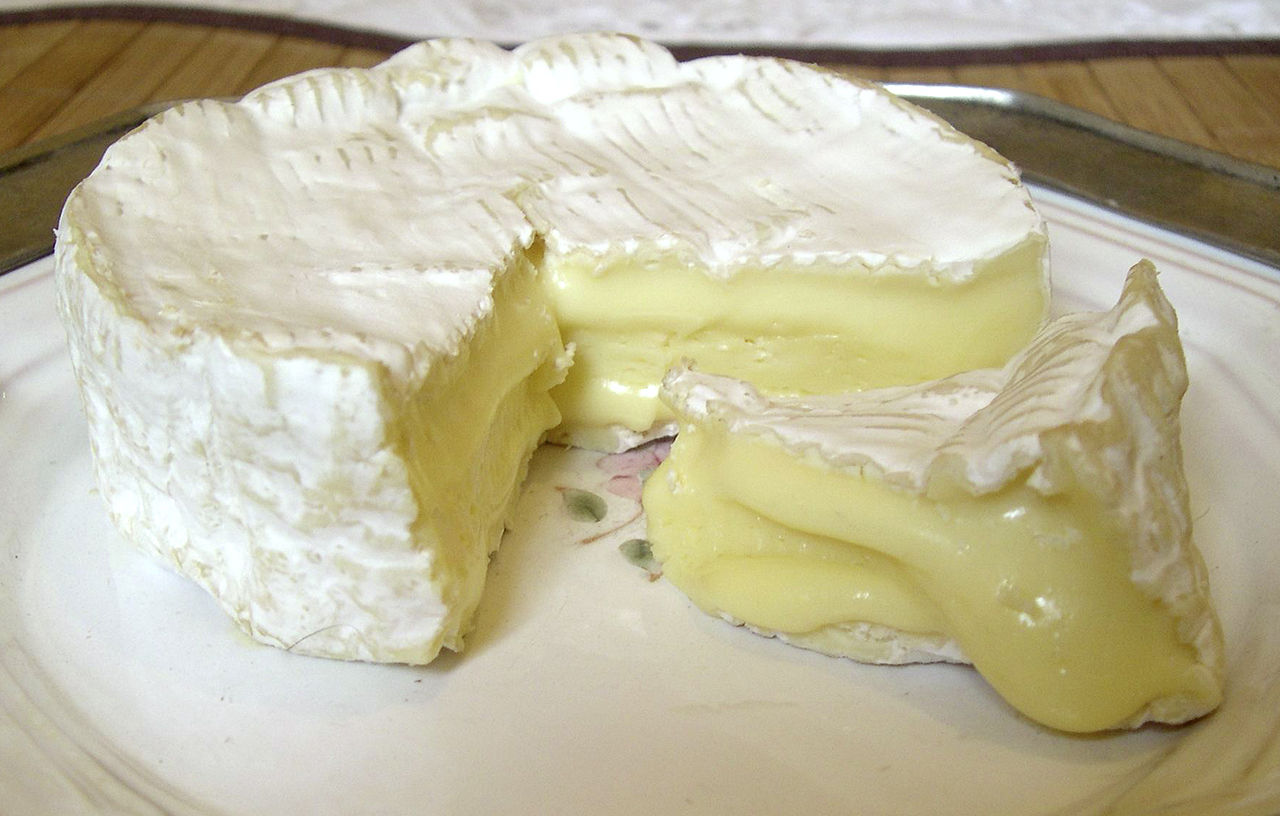
Camembert  is a soft, creamy, surface-ripened cow's milk cheese. It was first made in the late 18th century at Camembert, Normandy in northern France. "Camembert de Normandie" is required by law to be made only with unpasteurized milk from "Vaches Normandes" cows.
The cheese is made by inoculating warmed milk with mesophilic bacteria, then adding rennet and allowing the mixture to coagulate. The curd is then cut into roughly 1 cm (1/2 inch) cubes, salted, and transferred to low cylindrical camembert molds. The molds are turned every six to twelve hours to allow the whey to drain evenly from the cut curds; after 48 hours, each mold contains a flat, cylindrical, solid cheese mass weighing generally 250 grams (about 9 oz). At this point the fresh cheese is hard, crumbly, and bland.

The surface of each cheese is then sprayed with an aqueous suspension of the mold Penicillium camemberti, and the cheeses are left to ripen for a legally required minimum of three weeks. This affinage produces the distinctive bloomy, edible rind and creamy interior texture characteristic of the cheese. Once the cheeses are sufficiently ripe, they are wrapped in paper and may be placed in wooden boxes for transport.

Comte
 
Comté (formerly Gruyère de Comté) is a hard French cheese made from unpasteurized cow's milk in the Franche-Comté region of eastern France. Comté has the highest production of all French AOC cheeses, around 40,000 tons annually.
The cheese is made in flat circular discs, each between 40 cm (16 in) and 70 cm (28 in) in diameter, and around 10 cm (4 in) in height. The rind is usually a dusty-brown color, and the internal pâte is a pale creamy yellow. The texture is relatively hard and flexible, and the taste is strong and slightly sweet.

Fresh from the farm, milk is poured into large copper vats where it is gently warmed. Each cheese requires up to 600 litres (160 US gal) of milk. Rennet is added, causing the milk to coagulate. The curds are then cut into tiny white grains that are the size of rice or wheat which are then stirred before being heated again for around 30 minutes. The contents are then placed into molds and the whey is pressed out. After several hours the mold is opened and left to mature in cellars, first for a few weeks at the dairy, and then over several months elsewhere.

The manufacture of Comté has been controlled by AOC regulations since it became one of the first cheeses to receive AOC recognition in 1958, with full regulations introduced in 1976. The AOC regulations for Comté prescribe:

·        Only milk from Montbéliarde or French Simmental cows (or cross breeds of the two) is permitted.

·        There must be no more than 1.3 cows per hectare of pasture.

·        Fertilization of pasture is limited, and cows may only be fed fresh, natural feed, with no silage.

·        The milk must be transported to the site of production immediately after milking.

·        Renneting must be carried out within a stipulated time after milking, according to the storage temperature of the milk.

·        The milk must be used raw. Only one heating of the milk may occur, and that must be during renneting. It may be heated to no more than 40 °C (104 °F).

·        Salt may only be applied directly to the surface of the cheese.

·        A casein label containing the date of production must be attached to the side of the cheese, and maturing must continue for at least four months.

·        No grated cheese may be sold under the Comté name.

Roquefort
 
Roquefort  is a sheep milk blue cheese from the south of France, and together with Bleu d'Auvergne, Stilton, and Gorgonzola is one of the world's best known blue cheeses. Though similar cheeses are produced elsewhere, EU law dictates that only those cheeses aged in the natural Combalou caves of Roquefort-sur-Soulzon may bear the name Roquefort, as it is a recognized geographical indication, or has a protected designation of origin.
The cheese is white, tangy, crumbly and slightly moist, with distinctive veins of blue mold. It has characteristic odor and flavor with a notable taste of butyric acid; the blue veins provide a sharp tang. It has no rind; the exterior is edible and slightly salty. A typical wheel of Roquefort weighs between 2.5 and 3 kilograms (5.5 and 6.6 pounds), and is about 10 cm (4 inches) thick. Each kilogram of finished cheese requires about 4.5 liters (1.2 U.S. gal) of milk to produce. Roquefort is known in France as the king of cheeses.

The mold that gives Roquefort its distinctive character (Penicillium roqueforti) is found in the soil of the local caves. Traditionally, the cheesemakers extracted it by leaving bread in the caves for six to eight weeks until it was consumed by the mold. The interior of the bread was then dried to produce a powder. In modern times, the mold can be grown in a laboratory, which allows for greater consistency. The mold may either be added to the curd or introduced as an aerosol through holes poked in the rind.

Roquefort is made entirely from the milk of the Lacaune, Manech and Basco-Béarnaise breeds of sheep. The cheese is produced throughout the département of Aveyron and part of the nearby départements of Aude, Lozère, Gard, Hérault and Tarn.

The regulations that govern the production of Roquefort have been laid down over a number of decrees by the INAO. These include:

·        All milk used must be delivered at least 20 days after lambing has taken place.

·        The sheep must be on pasture, whenever possible, in an area including most of Aveyron and parts of neighboring départements. At least 3/4 of any grain or fodder fed must come from the area.

·        The milk must be whole, raw (not heated above 34 °C; 93.2 °F), and unfiltered except to remove macroscopic particles.

·        The addition of rennet must occur within 48 hours of milking.

·        The Penicillium roqueforti used in the production must be produced in France from the natural caves of Roquefort-sur-Soulzon.

·        The salting process must be performed using dry salt.

·        The whole process of maturation, cutting, packaging and refrigeration of the cheese must take place in the commune of Roquefort-sur-Soulzon.

As of 2009, there are seven Roquefort producers. Around three million cheeses were made in 2005 (18,830 tons) making it, after Comté, France's second most popular cheese.
(reference: Wikipedia)

 
Street Market "Fromager"
 
 
Mangez du fromage !