Wednesday, August 23, 2017

Qu’est-il arrivé à Napoléon II ?

If you’ve been following my blogs, and specifically have read my earliest posts, you know that I have no qualms pointing out my own deficiencies …. today I admit that history has never been a strength for me but as I get older (and older …. and older) I am more and more fascinated with learning history – particularly the histories of England and France …. (I better be studying French history, it will be part of the test for citizenship!) ….. So, another confession – although I knew the basics about Napoléon (Bonaparte) : short (nope, he wasn’t, he was the average size for the times); exiled to Elba (yep); and the poster boy for narcissism (not sure – the juries out on that one) ….. What I didn’t ever know, until I moved to here to France, was that there was a Napoléon I (Bonaparte) and a Napoléon III …..both were “Emperor(s) of the French” and boy was I confused until I realized they were two different people (although related) ….


Napoléon I, the Great (Emperor of the French, 1804 – 1814 and 20 March – 8 July 1815)

(Napoléon Bonaparte; Napoléon I)
 
Born "Napoléone di Buonaparte" (15 August 1769 – 5 May 1821), in Corsica to a relatively modest family from the minor nobility, was a French military and political leader who rose to prominence during the French Revolution and led several successful campaigns during the French Revolutionary Wars. As Napoléon I, he crowned himself Emperor of the French from 1804 until 1814, and again in 1815. Napoléon dominated European and global affairs for more than a decade while leading France against a series of coalitions in the Napoléonic Wars. He won most of these wars and the vast majority of his battles, building a large empire that ruled over continental Europe before its final collapse in 1815. One of the greatest commanders in history, his wars and campaigns are studied at military schools worldwide. Napoléon's political and cultural legacy has ensured his status as one of the most celebrated and controversial leaders in human history.

The French Revolution began 1789 and Napoléon rapidly rose through the ranks of the military, becoming a general at age 24. At age 26, he began his first military campaign against the Austrians and their Italian allies—winning virtually every battle, conquering the Italian Peninsula in a year, and becoming a national hero. In 1798, he led a military expedition to Egypt that served as a springboard to political power. He engineered a coup in November 1799 and became First Consul of the Republic. His ambition and public approval inspired him to go further, and in 1804 he became the first Emperor of the French.

The Allies invaded France and captured Paris in the spring of 1814, forcing Napoléon to abdicate, signing the “Act of Abdication” on 11 April 1814 at the Château de Fontainebleau.
 (Abdication table; Château de Fontainebleau )
He was exiled to the island of Elba which he escaped from in February 1815 and took control of France once again. The Allies responded defeating Napoléon at the Battle of Waterloo in June. The British exiled him to the remote island of Saint Helena in the South Atlantic, where he spent the remainder of his years. His death in 1821 at the age of 51 was received with surprise, shock, and grief throughout Europe, leaving behind a memory that still persists.

In 1840, King Louis Philippe I obtained permission from the British to return Napoléon's remains to France. On 15 December 1840 a state funeral was held. The hearse proceeded from the Arc de Triomphe down the Champs-Élysées, across the Place de la Concorde to the Esplanade des Invalides and then to the cupola in St Jérôme's Chapel, where it remained until the tomb designed by Louis Visconti was completed. In 1861, Napoléon's remains were entombed in a porphyry stone sarcophagus in the crypt under the dome at Les Invalides.

(Napoléon I tomb; Les Invalides)
Napoléon had an extensive and powerful influence on the modern world, bringing liberal reforms to the numerous territories that he conquered and controlled, such as the Low Countries, Switzerland, and large parts of modern Italy and Germany. He implemented fundamental liberal policies in France and throughout Western Europe. His legal achievement, the Napoléonic Code, has influenced the legal systems of more than 70 nations around the world. British historian Andrew Roberts stated, "The ideas that underpin our modern world—meritocracy, equality before the law, property rights, religious toleration, modern secular education, sound finances, and so on—were championed, consolidated, codified and geographically extended by Napoléon. To them he added a rational and efficient local administration, an end to rural banditry, the encouragement of science and the arts, the abolition of feudalism and the greatest codification of laws since the fall of the Roman Empire.”

The Napoléonic code was adopted throughout much of Europe, though only in the lands he conquered, and remained in force after Napoléon's defeat. Napoléon said: "My true glory is not to have won forty battles ... Waterloo will erase the memory of so many victories. ... But ... what will live forever is my Civil Code." The Code influences a quarter of the world's jurisdictions such as that of in Europe, the Americas and Africa.

Napoléon directly overthrew feudal remains in much of Western Europe. He liberalized property laws, ended seigneurial dues, abolished the guild of merchants and craftsmen to facilitate entrepreneurship, legalized divorce, closed the Jewish ghettos and made Jews equal to everyone else. The Inquisition ended as did the Holy Roman Empire. The power of church courts and religious authority was sharply reduced and equality under the law was proclaimed for all men.

Additionally, Napoléon instituted various reforms, such as higher education, a tax code, road and sewer systems, and established the Banque de France, the first central bank in French history. He negotiated the Concordat of 1801 with the Catholic Church, which sought to reconcile the mostly Catholic population to his regime. It was presented alongside the Organic Articles, which regulated public worship in France. He dissolved the Holy Roman Empire prior to German Unification later in the 19th century. The sale of the Louisiana Territory to the United States doubled the size of the United States. In May 1802, he instituted the Legion of Honour, a substitute for the old royalist decorations and orders of chivalry, to encourage civilian and military achievements; the order is still the highest decoration in France.

There are critiques of Napoléon. In the political realm, historians debate whether Napoléon was "an enlightened despot who laid the foundations of modern Europe or, instead, a megalomaniac who wrought greater misery than any man before the coming of Hitler." Many historians have concluded that he had grandiose foreign policy ambitions. The Continental powers as late as 1808 were willing to give him nearly all of his gains and titles, but some scholars maintain he was overly aggressive and pushed for too much, until his empire collapsed.

Napoléon institutionalized plunder of conquered territories: French museums contain art stolen by Napoléon's forces from across Europe.  Artefacts were brought to the Musée du Louvre for a grand central museum.

Critics argue Napoléon's true legacy must reflect the loss of status for France and needless deaths brought by his rule: historian Victor Davis Hanson writes, "After all, the military record is unquestioned—17 years of wars, perhaps six million Europeans dead, France bankrupt, her overseas colonies lost." McLynn states that, "He can be viewed as the man who set back European economic life for a generation by the dislocating impact of his wars." Vincent Cronin replies that such criticism relies on the flawed premise that Napoléon was responsible for the wars which bear his name, when in fact France was the victim of a series of coalitions which aimed to destroy the ideals of the Revolution.

After the fall of Napoléon, not only was Napoléonic Code retained by conquered countries including the Netherlands, Belgium, parts of Italy and Germany, but has been used as the basis of certain parts of law outside Europe including the Dominican Republic, the US state of Louisiana and the Canadian province of Quebec. The memory of Napoléon in Poland is favorable, for his support for independence and opposition to Russia, his legal code, the abolition of serfdom, and the introduction of modern middle class bureaucracies.

Napoléon could be considered one of the founders of modern Germany. After dissolving the Holy Roman Empire, he reduced the number of German states from 300 to less than 50, prior to the German Unification. A byproduct of the French occupation was a strong development in German nationalism. Napoléon also significantly aided the United States when he agreed to sell the territory of Louisiana for 15 million dollars during the presidency of Thomas Jefferson. That territory almost doubled the size of the United States, adding the equivalent of 13 states to the Union

The myth of the "Napoléon Complex"—named after him to describe men who have an inferiority complex—stems primarily from the fact that he was listed, incorrectly, as 5 feet 2 inches at the time of his death. He was 168 centimeters (5 ft 6 in) tall, an average height for a man of that period.

Napoléon III (Emperor of the French, 1852-1870)

(Napoléon III)
Louis-Napoléon Bonaparte (born Charles-Louis Napoléon Bonaparte; 20 April 1808 – 9 January 1873) was the only President (1848–52) of the French Second Republic and, as Napoléon III, the Emperor (1852–70) of the Second French Empire. He was the nephew and heir of Napoléon I. He was the first President of France, elected by a 74.2 percent of direct popular votes cast in 1848. He was blocked by the Constitution and Parliament from running for a second term, so he organized a coup d'état in 1851 and then took the throne as Napoléon III on 2 December 1852, the forty-eighth anniversary of Napoléon I's coronation. He remains the longest-serving French head of state since the French Revolution.

During the first years of the Empire, Napoléon's government imposed censorship and harsh repressive measures against his opponents. Some six thousand were imprisoned or sent to penal colonies until 1859. Thousands more went into voluntary exile abroad, including Victor Hugo. From 1862 onwards, he relaxed government censorship, and his regime came to be known as the "Liberal Empire." Many of his opponents returned to France and became members of the National Assembly.

Napoléon III is best known today for his grand reconstruction of Paris, carried out by his prefect of the Seine, Baron Haussmann. He launched similar public works projects in Marseille, Lyon, and other French cities. Napoléon III modernized the French banking system, greatly expanded and consolidated the French railway system, and made the French merchant marine the second largest in the world. He promoted the building of the Suez Canal and established modern agriculture, which ended famines in France and made France an agricultural exporter. Napoléon III negotiated the 1860 Cobden–Chevalier free trade agreement with Britain and similar agreements with France's other European trading partners. Social reforms included giving French workers the right to strike and the right to organize. Women's education greatly expanded, as did the list of required subjects in public schools

Beginning in 1866, Napoléon had to face the mounting power of Prussia, as Chancellor Otto von Bismarck sought German unification under Prussian leadership. In July 1870, Napoléon entered the Franco-Prussian War without allies and with inferior military forces. The French army was rapidly defeated and Napoléon III was captured at the Battle of Sedan. The French Third Republic was proclaimed in Paris, and Napoléon went into exile in England, where he died in 1873.

Among the commercial innovations encouraged by Napoléon III were the first department stores. Bon Marché opened in 1852, followed by Au Printemps in 1865

One of the first priorities of Napoléon III was the modernization of the French economy, which had fallen far behind that of the United Kingdom and some of the German states. Political economics had long been a passion of the Emperor: While in Britain he had visited factories and railway yards, and in prison he had studied and written about the sugar industry and policies to reduce poverty. He wanted the government to play an active, not a passive, role in the economy. In 1839, he had written: "Government is not a necessary evil, as some people claim; it is instead the benevolent motor for the whole social organism." He did not advocate the government getting directly involved in industry. Instead, the government took a very active role in building the infrastructure for economic growth; stimulating the stock market and investment banks to provide credit; building railways, ports, canals and roads; and providing training and education. He also opened up French markets to foreign goods, such as railway tracks from England, forcing French industry to become more efficient and more competitive.

Beginning in 1852, he encouraged the creation of new banks, such as Crédit Mobilier, which sold shares to the public and provided loans to both private industry and to the government. Crédit Lyonnais was founded in 1863, and Société Générale in 1864. These banks provided the funding for Napoléon III's major projects, from railway and canals to the rebuilding of Paris.

New shipping lines were created and ports rebuilt in Marseille and Le Havre, which connected France by sea to the USA, Latin America, North Africa and the Far East. During the Empire the number of steamships tripled, and by 1870 France possessed, after England, the second-largest maritime fleet in the world.

The rebuilding of central Paris also encouraged commercial expansion and innovation. The first department store, Bon Marché, opened in Paris in 1852 in a modest building, and expanded rapidly, its income going from 450,000 francs a year to 20 million. Its founder, Aristide Boucicaut, commissioned a new glass and iron building, designed by Louis-Charles Boileau and Gustave Eiffel and opened in 1869, that became the model for the modern department store. Other department stores quickly appeared: Au Printemps in 1865 and La Samaritaine in 1870.

Napoléon III's program also included reclaiming farmland and reforestation. One such project in the Gironde department drained and reforested 10,000 square kilometers (3,900 square miles) of moorland, creating the Landes forest, the largest maritime pine forest in Europe

The Avenue de l'Opéra, was one of the new boulevards created by Napoléon III. The new buildings on the boulevards were required to be all of the same height and same basic facade design, and all faced with cream colored stone, giving the city center its distinctive harmony.

Napoléon III began his regime by launching a series of enormous public works projects in Paris, hiring tens of thousands of workers to improve the sanitation, water supply and traffic circulation of the city. To direct this task, he named a new Prefect of the Seine department, Georges Eugène Haussmann, and gave him extraordinary powers to rebuild the center of the city. He installed a large map of Paris in a central position in his office, and he and Haussmann planned the new Paris.

To accommodate the growing population and those who would be forced from the center by the new boulevards and squares Napoléon III planned to build, he issued in 1860 a decree annexing eleven surrounding communes (municipalities), and increasing the number of arrondisments (city boroughs) from twelve to twenty, enlarging Paris to its modern boundaries with the exception of the two major city parks (Bois de Boulogne and Bois de Vincennes) which only became part of the French capital in 1920.

Napoléon III built two new railway stations: the Gare de Lyon (1855) and the Gare du Nord (1865). He completed Les Halles, the great cast iron and glass pavilioned produce market in the center of the city, and built a new municipal hospital, the Hôtel-Dieu, in the place of crumbling medieval buildings on the Ile de la Cité. The signature architectural landmark was the Paris Opera, the largest theater in the world, designed by Charles Garnier, crowning the center of Napoléon III's new Paris.

Napoléon III also wanted to build new parks and gardens for the recreation and relaxation of the Parisians, particularly those in the new neighborhoods of the expanding city. Napoléon III's new parks were inspired by his memories of the parks in London, especially Hyde Park, where he had strolled and promenaded in a carriage while in exile; but he wanted to build on a much larger scale. Working with Haussmann and Jean-Charles Alphand, the engineer who headed the new Service of Promenades and Plantations, he laid out a plan for four major parks at the cardinal points of the compass around the city. Thousands of workers and gardeners began to dig lakes, build cascades, plant lawns, flowerbeds and trees, and construct chalets and grottoes. Napoléon III transformed the Bois de Boulogne into a park (1852–58) to the west of Paris: the Bois de Vincennes (1860–65) to the east; he created the Parc des Buttes-Chaumont (1865–67) to the north, and the Parc Montsouris (1865–78) to the south.

In addition to building the four large parks, Napoléon had the city's older parks, including Parc Monceau, formerly owned by the Orléans family, and the superb Jardin du Luxembourg, refurbished and replanted. He also created some twenty small parks and gardens in the neighborhoods, as miniature versions of his large parks. Alphand termed these small parks "Green and flowering salons." The intention of Napoléon's plan was to have one park in each of the eighty "quartiers" (neighborhoods) of Paris, so that no one was more than a ten-minute's walk from such a park. The parks were an immediate success with all classes of Parisians

Napoléon III also began or completed the restoration of several important historic landmarks, carried out for him by Eugène Viollet-le-Duc. He restored the flèche, or spire, of the Cathedral of Notre-Dame de Paris, which had been partially destroyed and desecrated during the French Revolution. In 1855 he completed the restoration, begun in 1845, of the stained glass windows of the Sainte-Chapelle, and in 1862 he declared it a national historical monument. In 1853, he approved and provided funding for Viollet-le-Duc's restoration of the medieval town of Carcassonne. He also sponsored Viollet-le-Duc's restoration of the Château de Vincennes and the Château de Pierrefonds. In 1862, he closed the prison which had occupied the Abbey of Mont-Saint-Michel since the French Revolution, where many important political prisoners had been held, so it could be restored and opened to the public

From the beginning of his reign Napoléon III launched a series of social reforms aimed at improving the life of the working class. He began with small projects, such as opening up two clinics in Paris for sick and injured workers, a program of legal assistance to those unable to afford it, and subsidies to companies which built low-cost housing for their workers. He outlawed the practice of employers taking possession of or making comments in the work document that every employee was required to carry; negative comments meant that workers were unable to get other jobs. In 1866, he encouraged the creation of a state insurance fund to help workers or peasants who became disabled, and to help their widows and families.

His most important social reform was the 1864 law which gave French workers the right to strike, which had been forbidden since 1810. In 1866 he added to this an "Edict of Tolerance," which gave factory workers the right to organize. He issued a decree regulating the treatment of apprentices, limited working hours on Sundays and holidays, and removed from the Napoléonic Code the infamous article 1781, which said that the declaration of the employer, even without proof, would be given more weight by the court than the word of the employee.

Napoléon III also directed the building of the French railway network, which greatly contributed to the development of the coal mining and steel industry in France, thereby radically changing the nature of the French economy, which entered the modern age of large-scale capitalism. The French economy, the second largest in the world at the time (behind the British economy), experienced a very strong growth during the reign of Napoléon III. Names such as steel tycoon Eugène Schneider or banking mogul James de Rothschild are symbols of the period. Two of France's largest banks, Société Générale and Crédit Lyonnais, still in existence today, were founded during that period. The French stock market also expanded prodigiously, with many coal mining and steel companies issuing stocks. Historians credit Napoléon III chiefly for supporting the railways, but not otherwise building the economy.

Napoléon's military pressure and Russian mistakes, culminating in the Crimean War, dealt a fatal blow to the Concert of Europe. It was based on stability and balance of powers, whereas Napoléon attempted to rearrange the world map to France's favor even when it involved radical and potentially revolutionary changes in politics. A 12-pound cannon designed by France is commonly referred to as a Napoléon cannon or 12-pounder Napoléon in his honor.

(St. Michael's Abbey, England)
Following the fall of the Second French Empire in 1870, Napoléon III, his wife Empress Eugénie and their son the Prince Imperial were exiled from France and took up residence in Chislehurst, England, where Napoleon III died in 1873. He was originally buried at St Mary's Catholic Church, Chislehurst, but, following the death of the Prince Imperial in 1879, the grief-stricken Eugénie set about building a monument to her family. She founded the abbey, St. Michales Abbey (Farnborough, England) in 1881 as a mausoleum for her husband and son, wishing that the burial place should be a place of prayer and silence. The Abbey included an Imperial Crypt, modelled on the altar of St Louis in France, where the Emperor had originally desired to be buried, where Eugénie was later buried alongside her husband and son. All three rest in granite sarcophagi provided by Queen Victoria. The Abbey Church itself was designed in an eclectic flamboyant gothic style by the renowned French architect Gabriel-Hippolyte Destailleur.

So, to answer the question that the title of this blog asks – what happened to Napoléon II (Napoléon II, King of Rome, “the Eaglet”) ….

(Napoléon II)
Napoléon François Charles Joseph Bonaparte (20 March 1811 – 22 July 1832), Prince Imperial, King of Rome, was the son of Napoléon I, Emperor of the French, and his second wife, Archduchess Marie Louise of Austria.

By Title III, article 9 of the French Constitution of the time, he was Prince Imperial, but he was also known from birth as the King of Rome, which Napoléon I declared was the courtesy title of the heir apparent. His nickname of L'Aiglon ("the Eaglet") was awarded posthumously and was popularized by the Edmond Rostand play, L'Aiglon.

When Napoléon I abdicated on 4 April 1814, he named his son as Emperor. However, the coalition partners that had defeated him refused to acknowledge his son as successor; thus Napoléon I was forced to abdicate unconditionally a number of days later. Although Napoléon II never actually ruled France, he was briefly the titular Emperor of the French in 1815 after the fall of his father. When his cousin Louis-Napoléon Bonaparte became the next emperor by founding the Second French Empire in 1852, he called himself Napoléon III to acknowledge Napoléon II and his brief reign.

(Napoléon II tomb; Les Invalides)

 He died at the age of 21 and is buried at Les Invalides, along with his father, Napoléon I.

Ç'est tout avec les Napoléons

(special credit to Wikipedia for information on the Napoléons)


Friday, February 10, 2017

Curiosités Intérressant


Well, after quite a dry spell for posting blogs I have now written two in a short period of time – truth be told – when reading my first blog posting for 2017, I must admit it is rather boring, and thinking about it, I believe I really wrote it for me – to see what I’ve done while I’ve lived here, to see if I’ve accomplished my goals for moving here and I see the answer is both yes and no.

Hopefully with this blog I’m back to my old self and that you will find it interesting, educational and informative (is there a difference between educational and informative?).

Shortly after I moved here I found an app named “Secrets de Paris”. Each day it provides an interesting tidbit about somewhere in Paris to visit. I’ve already introduced some things from it in past blogs (rue Crémieux; oldest house). If you visit Paris and have already seen all the tourist sites, I suggest you download this app and find some of the “off the beaten path” quirky things that Paris has to offer. And for those of you who haven’t been here and have no intention on coming – well, here’s to you:

[note: 1) “eme” is an abbreviation for the word arrondissement, and 2) click on the photographs to enlarge them in a separate window]


Square René Viviani

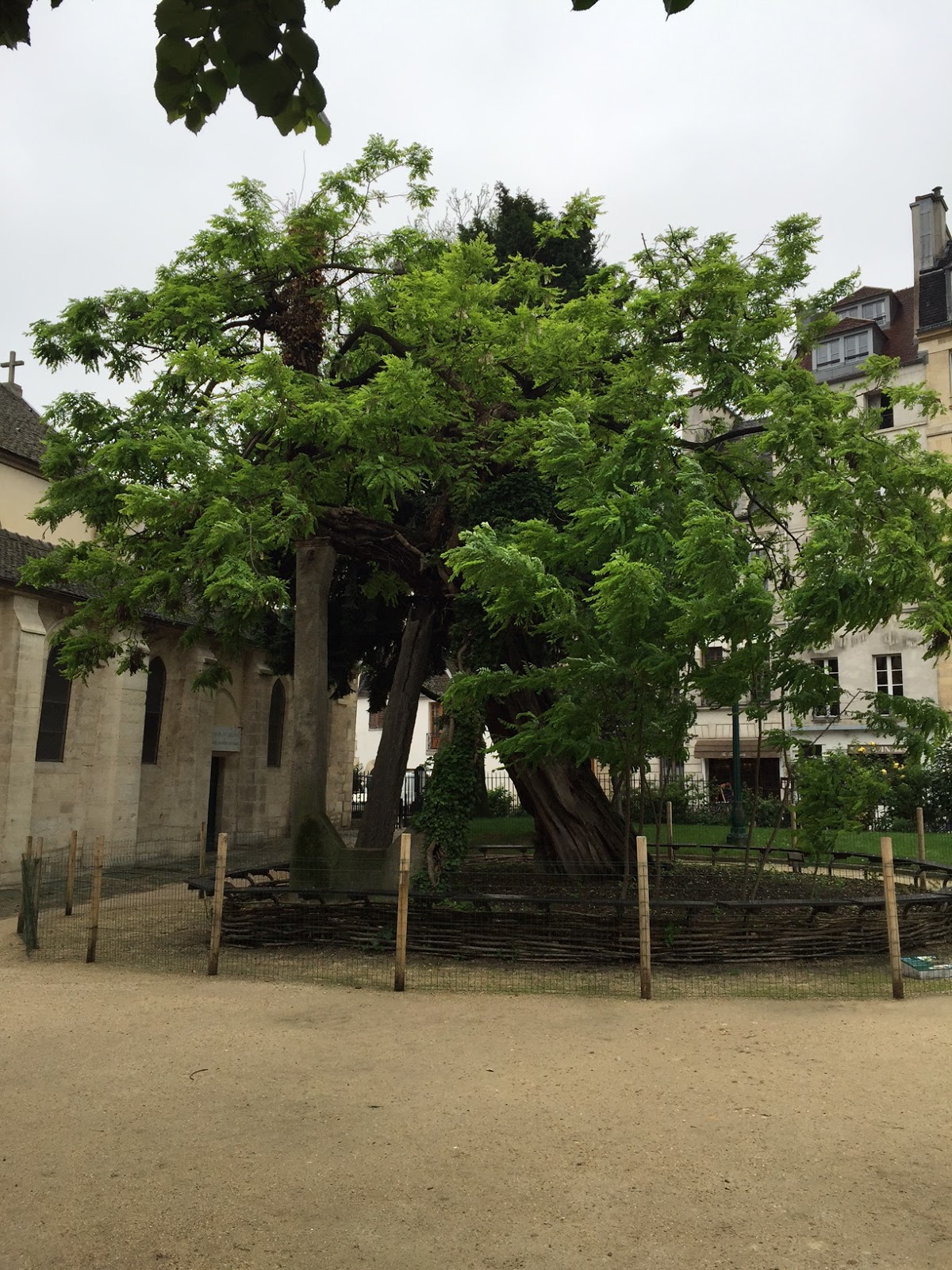
Oldest Tree: Square René Viviani (5eme)

The Square René Viviani is a city park located slightly to the north of the Gothic church of Saint-Julien-le-Pauvre, built at the same time as Notre-Dame Cathedral de Paris and consequently is one of Paris' oldest churches. Disaffected during the Revolution, in the 19th century the ruinous church was taken over by the city's Greek Melchite Church and is today the center of that religious community in Paris.

The square is noted for being the site of the oldest planted tree in Paris. The robinia pseudoacacia, a species commonly known as a locust tree, is believed to have been planted by its namesake, Jean Robin (1550–1620), in 1601; if so, it has now been standing on the rive gauche for over four hundred years. It is supported by two concrete crutches. The tree lost its upper branches to a shell during World War I, but it proves its continuing vitality by blooming every year.


rue des Degrés

Shortest Street: le rue des Degrés (2eme)

At 3.3 metres (10.8 feet) wide and 5.5 metres (18 feet) long the rue des
Degrés has the distinction of being the shortest street in Paris. It’s been here since the middle of the seventeenth-century.

The rue des Degrés, owing its name to its inclination, is comprised of just fourteen steps linking the rue de Clery and the rue Beauregard. These two streets run along the former line of the Charles V wall, built from 1356 to 1383 and demolished in the seventeenth-century to make way for the Grands Boulevards.

At the corner of the rue des Degrés and rue Beauregard, a historic plaque reminds us that at this place the Baron de Batz attempted with some men to help Louis XVI escape on the morning of January 21, 1793 – the day of the King's execution on the Place de la Concorde.


passage du Plateau

Narrowest Street: le passage du Plateau (19eme)

Located south of the park of Buttes-Chaumont it is one of the narrowest passageways in Paris. It measures between 1 and 1.5 meters (3.2 – 4.9 feet) wide. Besides its narrowness, this passageway is remarkable because it contains beautiful ateliers.

That is my friend in the photograph, Jacqui, demonstrating just how narrow the street is – as she can touch the buildings on either side easily.


passage de l’Ancre

Oldest Road: le passage de l’Ancre, 223 rue Saint-Martin (3eme)

passage de l’Ancre is a small unusual private road that one shouldn’t miss while walking through the Marais and Beaubourg. Part way down the road is PEP’S, opened in the 1960’s, specializing in the sale and reparation of umbrellas, parasols, and canes.

The passage was named passage de l’Ancre-Royale but during the French Revolution became passage de l’Ancre-Nationale and today it is simply the passage de l’Ancre.

This is where in the 1640’s Monsieur Sauvage set up the first taxi (fiacre) service at his inn - Hôtel Saint-Fiacre. A fiacre, known as a hackney carriage in English, is a small horse-drawn carriage, with four wheels, formerly used for hire like a taxi. Saint-Fiacre became known as the patron saint for taxi drivers.


passage des Panoramas

Oldest Covered Passage: le passage des Panoramas, 11 boulevard Montmartre (2eme)

The passage des Panoramas is the oldest of the covered passages of Paris. It is one of the earliest venues of the Parisian philatelic (stamp collecting) trade, and it was one of the first covered commercial passageways in Europe. Bazaars and souks in the Orient had roofed commercial passageways centuries earlier but the passage de Panoramas innovated in having glazed roofing and, later on, in 1817, gas lights for illumination. It was an ancestor of the city gallerias of the 19th century and the covered suburban and city shopping malls of the 20th century.

Built in 1799, the passage was opened in 1800 on the site of the town residence of the Marechal de Montmorency, Duke of Luxembourg, which had been built in 1704. The doorway of the modern building, of the house, which opened on rue Saint-Marc, facing the rue des Panoramas, was the gateway of the original mansion.

Its name came from an attraction built on the site; two large rotundas where panoramic paintings of Paris, Toulon, Rome, Jerusalem, and other famous cities were displayed. They were a business venture of the American inventor Robert Fulton, who had come to Paris to offer his latest inventions, the steamboat, submarine, and torpedo, to Napoleon and the French Directory. While waiting for an answer, Fulton earned money from his exhibition. Napoleon, who had little interest in the navy, finally rejected Fulton's projects.

In 1800 Paris streets were narrow, dark, muddy and crowded, and very few had sidewalks or lighting; they were very unpleasant for shopping. The first indoor gallery, at the Palais Royal, had opened in 1786, followed by the passage Feydau in 1790-91, the passage du Caire in 1799, and the passage des Panoramas in 1800. The rotundas were destroyed in 1831.

In the 1830s, the architect Jean-Louis Victor Grisart renovated the passage and created three additional galleries inside the block of houses: the Saint-Marc gallery parallel with the passage, the gallery of the Varietes which gives access to the entry of the artists of the theatre of the Varietes, and the Feydeau galleries and Montmartre.

Stern the famous engraver settled there in 1834, and then merchants of postcards and postage stamps, and some restaurants moved in. The part of the passage close to the boulevard Montmartre is richly decorated, while the distant part is more modest.

The passage, as it was in 1867, is described in chapter VII of Émile Zola's novel Nana.


Pont Neuf

Oldest Sidewalk: le Pont Neuf

The Pont Neuf (New Bridge) is the oldest standing bridge across the river Seine. Its name, which was given to distinguish it from older bridges that were lined on both sides with houses, has remained after all of those were replaced. It stands by the western (downstream) point of the Île de la Cité, the island in the middle of the river that was, between 250 and 225 BC, the birthplace of Paris, then known as Lutetia, and during the medieval period, the heart of the city.

As early as 1550, Henry II was asked to build a bridge there because the existing Pont Notre-Dame was overloaded, but the expense was too much at the time.

In February 1578 the decision to build the bridge was made by Henry III who laid its first stone in 1578, the year when the foundations of four piers and one abutment were completed.

It was decided to allow houses to be built on the bridge (though they never were). That required the widening of the bridge. After a long delay beginning in 1588, due to political unrest and to the Wars of Religion, construction was resumed in 1599 under the reign of Henry IV. The bridge was opened to traffic in 1604 and completed in July 1606. It was inaugurated by Henri IV in 1607.


39 rue du Chateau d’Eau

Smallest Building: 39 rue du Chateau d’Eau (10eme)

The building is only 1.10 meters wide (3.6 feet), 5 meters high (16.4 feet), and 3 meters (9.8 feet) deep and has both a ground and second floor. According to legend, the building is perhaps the result of an inheritance dispute between the two buildings on either side next door.

Originally the gap between the two buildings was a narrow passageway, but following a disagreement about ownership and access, one of the parties decided to end the argument by filling the space with a new property.

The property was officially recognized with its own number in the street, but was never really more than a tiny shop unit at ground level (originally a shoemaker) with a room above, which actually connects to the first-floor property at number 41. A newspaper article at the end of the 19th century describes the property, pointing out that the room was home to a baby, the cot apparently taking up the entire space.

 
RATP/EDF Façade:

Three buildings (below) unlike all others – Paris includes several buildings that are not intended to be inhabited but whose façade conceals the true function. These façades are in all respects similar to those of the surrounding buildings and take up the usual Parisian elements (windows, gates, balconies, etc.), but are, in a way, trompe-l'œil. There are a total of 12 such façades in the City.

RATP (Régie Autonome des Transports Parisiens – public transportation):


44 rue d’Aboukir

44 rue d’Aboukir (2eme) – covers an air vent for the Metro system.


145 rue Lafayette

145 rue Lafayette (10eme) – covers an air vent for the Metro system.


EDF (Électricité de France – electric utility company):


14 rue Duvergier

14 rue Duvergier (19eme) – covers a power station


Prenez le temps de trouver des choses dans la vie qui se trouvent hors des sentiers battus


Tuesday, January 31, 2017

Ma première année ou plus


On September 1st I celebrated living in Paris for 1 year. My plan was to move here for two years – to travel in Europe and Eastern Europe – then decide if I wanted to live in Europe forever, and where. I picked Paris as my starting point because it is a good central hub that allows me to easily travel anywhere else in Europe and Eastern Europe. I knew my first 9 – 12 months would be spent assimilating to the European, and specifically French, culture (easily accomplished) and learning the French language (ha! Not even remotely accomplished). So, having been here a year I wanted to look back to see what my year looked like – but since I was remiss in completing my blog I’m now at 1 ½ years, so I’ll update you to the end of 2016:

Visitors: I was lucky enough throughout the year to be able to meet up with friends, old and new, from the States – Fred and Diana; Rosemary; MJ, Allen, Gail and Robert; Ilyana; David and Tessa; Arnie and Suzie; David and Beth; Jeanne and Jerry; Tony, Dominique and Andrew; Karen and Nancy; and Leonard, Terri and Art – all made Paris either a stop on their journey or the journey itself. For many of them Paris was a return visit, while for the others it was a first visit. Whether new or a return, it is always delightful to see my home town (ha! Paris is my home town – can you believe that???) through the eyes of other people.

New Friends: For me it’s not very easy to meet new people so this adventure of mine is certainly pushing my boundaries. I have been extremely fortunate to become friends with some pretty wonderful people – Jacqui, whom I met through an ExPat website, moved to Paris from the San Diego area and is married to a Frenchman. She has expertly guided me, with the patience of a saint, through the many ‘differences’ between living in the USA and in France ….. things such as introducing me to Castorama (like Home Depot) to accompanying me to my appointment at the Tax Office. A huge plus, is that I get to babysit her cat when she is out of town – woohoo (I sure do miss having a cat or two or three or four).  She has since moved back to Encinitas, which makes me very sad, but I’m hoping that she will soon return to Paris!
Bridgette, Lucien and Dominique, whom I met through friends from the States, they live just outside of Auxerre (France) which is about a 2 ½ hour train ride – it is in north-central France. I’ve been to their place a couple of times and they make jaunts to Paris frequently – usually when Dominique is on school break – to do things that the big city offers …. But they are also big rugby fans so they’ll come up for a day to watch a game too. It’s always nice to see them.
Another friend is Elisbeta who lives in a suburb of Paris but is from Poland. I met her in our language class … what is interesting there is that she speaks Polish and French, I speak English but somehow we figured out how to communicate with each other. Over the Easter week-end I went to Krakow, Poland to visit her in her hometown and meet her family. It was a lovely time.
I met one of my neighbors – Nathalie – when she happened to be walking by my apartment and saw me struggling to talk to a delivery person …. She stopped and translated for us …. She speaks perfect English and went to college in Atlanta. She and her daughter, Victoria, live on the floor above me and they both have helped me when I have “where do I …..” questions.  I’ve been invited to their apartment a number of times and I love spending time with them. Nathalie told me she doesn’t have the patience to help someone learn French, but she introduced me to two of her friends – Monique and Virginie – who both want to improve their English, so I meet up with them and we trade off – one meeting in English, the next in French (I bet you can guess whom is progressing better in the pairings …. Ha!)
I met Christopher when I was at the police department in the 5th arrondissement, touring the Police Museum. He is a civil police officer (they have two types of police officers here – civil for civil law, and criminal for criminal law) who speaks English and has a gregarious personality …. He is so informed about the history of Paris and knows all these off-the-beaten-path, really cool, places to visit. He’s also helping me (more like forcing me) with my French as he often pretends he has no idea what I’m saying if I speak or write in English – he always says “I don’t understand. In French, Nicolle” …. So the poor guy then has to try to figure out what I’m trying to convey – thank god he laughs easily, because with me trying to speak French we often are reduced to laughing fits.
And Muxu I met at a street market in a neighborhood close to me. It’s one of my favorite street markets (Avenue de Saxe) and I like to take visitors there because the vendors arrange their products so beautifully – it’s artistic. He is a vendor who sells scarves – and he has had a lot of business from me, because I just love scarves. I am addicted and it is hard for me to visit him without purchasing another scarf that I “just have to have”. He too helps me with learning French, as I also help him with English.

Travels: I moved here to travel, yet this first year – as I suspected – I did little traveling. I have gone a couple of times to a small village, Arcy-sur-Cure, which is located just outside of Auxerre – in the Bourgogne (Burgundy) region of France. My friends Bridgette and Lucien own a “Bread and Breakfast” at which I stay. Arcy-sur-Cure is a small commune in north-central France and the caves in that commune hold the second oldest cave painting known. The population is about 521.
Bridgette is a trained Chef, so I always have great food there. My first time there I was introduced to food from the Bourgogne region – the one that stands out the most is SNAILS. Oh Lordy, I really had no desire to eat any but I didn’t want to offend them (this was during my first meeting them) and their son, Dominique, was downing them like they were chocolate candy – I didn’t want a 10 year old kid showing me up so I ate one – with the entire table watching me, as well as my friend Fred videotaping the event – thank goodness he’s never been able to figure out how to download the video from his cell phone so that way I don’t feel obligated in sharing it with you ….. and I only ate the ONE … it was basically tasteless (the snail itself) – I felt like I had a small piece of rubber in my mouth that I was chewing on, all the flavors came from the garlic-butter sauce that it is in …… I could maybe come to like them if it was for the texture of the snail itself – again, like chewing rubber – and just the thought that I am eating a snail …. But I survived. I went to their place again for Thanksgiving where we had a traditional American Thanksgiving meal …. Well, with 21 people invited …. About ¾ spoke English, so I had people to talk to – the meal was excellent (of course – do Chefs ever make bad meals?) …. And it was a quite enjoyable couple of days there.
As you blog readers are already aware – I went to Krakow, Poland – I spent 4 days there, it is a beautiful city and the people were very warm and welcoming (see blog dated April 21, 2016).
In October I went to Mont Saint-Michel, about a 4 hour bus ride each way, which is an island commune in the Normandy area about a half mile off the north-west coast of France. The population is 44 people.  Since the 8th century AD it has been the home of a monastery and has always been a strategic fortification for France. What is so unique about it is that when the tide recedes you can walk to the island (daytime) and then in the evening when the tide comes back in the island is completely surrounded by water. The tides can vary greatly, at roughly 14 metres (46 ft) between high and low water marks.
I was in Malaga, Spain (Andalusia), which lies on the “Costa del Sol” of the Mediterranean, at the end of October – thanks to the Miranda clan. I was there for a week and we went all kinds of places – we actually stayed about 30 minutes outside of Malaga, in Calahonda …. Because this area is the southern coast of Spain on the Mediterranean Sea (I stuck my feet into it) the weather was warm and beautiful. Actually, the entire area reminded me of San Diego and sometimes of the drive to Yuma …. Other cities in Spain that we visited were: Marbella (posh resort), Ronda (bullfighting and arched bridges), and Granada (La Alhambra), along with some smaller towns. I am always fascinated by architecture and the Andalusia area had beautiful buildings most with the Moorish influence from the occupation centuries ago. A nice surprise for all of us was that Gibraltar (as in – the rock of) was about an hour away – so of course we went there too. It is a British overseas territory located near the southwestern tip of Europe near the Iberian Peninsula. At the top of the rock there is a nature reserve where the Barbary Macaque (rock apes) live – they look like monkeys to me!
The last place, outside of Paris, I visited was Chartres (France) in December. It is about 60 miles southwest of Paris and is known for its cathedral, the Cathédrale Notre-Dame de Chartres, which is considered one of the finest and best preserved Gothic cathedrals in France and in Europe. The stain glass windows in the cathedral are unique in that it is not known how the famous and unique blue, bleu de Chartres, of the glass was created, and it has been impossible to replicate it. It’s a small village with about 39,000 people.

Paris Sites: I’m often asked “What do you do?” ….. It’s kind of a hard question to answer, but my basic answer would be that I just live life everyday here ….. Some days I never leave my apartment – I have clean house, do laundry (including ironing the bed linens …. And, you’ll never believe this but I now iron my bath towels too ….. oh, just hit me in the head!) …. I grocery shop ….. Other days I just walk/wander around looking at things – there is so much to look at because there is nothing like Paris in the US ….. and other times I visit tourist known, and unknown, landmarks. So, to try to figure out what I’ve done this past year I’m listing the things I’ve “seen”:
The Eiffel Tower (I have to start with that one, as I’ve made more visits there than anywhere else – because it’s literally 2 blocks from my apartment and 7 minutes walking to its base ….. and I will admit, I’m still as in awe of it as the first time I saw it in 1998 …. It still takes my breath away each time I see it);
Parks: Champ de Mars; Square Saint-Lambert; Parc du Bois; Le Jardin d’Acclimatation; Jardin des Tuileries; Square René Viviani; Square du Vert-Galant; Parc Georges Brassens; Jardin Tino Rossi; Square Cambronne; Parc des Buttes-Chaumont; Jardin du Luxembourg
Suburbs of Paris: Boulogne-Billancourt; Saint Cloud; Saint-Ouen; La Défense; Sevrés; Saint-Denis; Vincennes; Bourget
Misc. Places: Seine River; Rue Crémieux; Canal Saint-Martin; Cirque Pinder; Garde Républicaine Quartier des Célestins
Parades: (may 8); Bastille Day (July 14)
Landmarks: Trocadéro; Invalides; Catacombes; Place de la Concord; Place de la République; Place de la Bastille; Notre Dame; Sainte Chapelle; Sacré-Cœur; Arc de Triomphe; Le Garnier (Opera house); Centre Georges Pompidou; Ecole Militaire; Archives Nationales; Abbey of Saint Germain des Près; Russian Ambassador House; Hôtel de Ville de Paris; Saint-Denis Gate; Saint-Martin Gate; Passage des Panoramas; National Library of France – François Mitterrand; Père-Lachaise Cemetery;  Moulin Rouge; Basilica of St. Denis; Château de Vincennes; Panthéon; Saint Etienne-du-Mort; Saint Sulpice; Saint-Eustache Parish
Districts: Montmartre; Le Marais; Montparnasse; Pigalle; Les Halles (and actually almost all districts in Paris)
Churches (attended): American Church of Paris; Calvary Chapel Paris; Hillsong
Music Scene/Sports: Le Grande Rex (to see the band my cousin is in); L’Olympia (Black Viola and 2Cellos); Euro2016 (International soccer)
Street Markets: Rue Cler; Grenelle (my neighborhood); Avenue de Saxe; Marche aux Puces
Shopping Centers: Beaugrenelle; Bizarre Hôtel de Ville; Les 4 Temps (La Défense); Galeries Lafayette; Le Bon Marche; Champs-Elysées;
Museums: Musée des Collections Historiques de la Préfecture de Police; Fondation Louis Vuitton; National Museum of Sevrés Céramiques; Musée de Picasso; Musée de l’Orangerie; Institute Pasteur; Conservatoire National des Arts & Métiers; Carnavalet Museum/Cernuschi Museum; Le Musée en Herbe; Musée Galliera de la Mode de la Ville de Paris; Musée de Chocolat; L’Aquarium de Paris; Le Bourget Musée Air et Espace; Musée Rodin; Grand Palais
Bridges: Pont Alexandre III; Pont d’Lena; Pont de Grenelle; Pont de Bir-Hakeim; Pont Neuf;(almost every bridge that crosses the Seine)
Places of the 13 November Terrorist Attacks: Le Petit Cambodge; Carillon Paris; Café Bonne Biere; Casa Nostra; Bataclan; La Belle Equipe; Le Comptoir Voltaire

Language: I went to 10 weeks of French lessons (very expensive – oh la la) and received my A1 certificate. I’m pretty proud of that, and I know I have to start somewhere, but in reality – I don’t speak French. I can read it fairly well, I can do okay writing it but the speaking part is still very painful for me and listening to it is worse – I just have a really hard time understanding the spoken word. I have a long way to go to get to the point where I can actually converse. But hey, I did, once, put three sentences together at the same time!!!!

I’m sure I’ve missed things that I’ve experienced in my first 16 months here … so that’s a picture of my life so far in Paris - I’ll close for now. My next blog will have pictures and will be about some quirky things in Paris !

Vivre la vie